














As codes and performance standards for building enclosures become increasingly stringent, it’s critical that Owners understand the key operational requirements that need to be met in order to achieve expected performance metrics. Building Enclosure Commissioning (BECx) is a quality-oriented process intended to help define, improve, and verify the performance of building enclosures so that you can better manage your risk and outcomes. In fact, many jurisdictions now require commissioning by third-party BECx providers.
In this webinar architect Chelsea Ames, architectural engineer Andrea DelGiudice, and civil engineer Martina Driscoll illustrate the key components of the BECx process and explain why an Owner may find it valuable to implement BECx on a project. Our case studies demonstrate the advantages of various BECx tasks so that you can make an informed decision on whether commissioning may be beneficial for your project.
By the end of the webinar, you will be able to:
• Describe what Building Enclosure Commissioning (BECx) is and what it entails
• Analyze when and why to include BECx in a project
• Summarize the process included in BECx throughout project phases, including predesign, design, preconstruction, construction, and post-occupancy
• Identify the expected core competencies of a BECx service provider and why they are important
more to learn
View this webinar in our interactive audience console to earn 1 AIA HSW learning unit, access related resources, submit questions to the presenters, and download a certificate of completion.
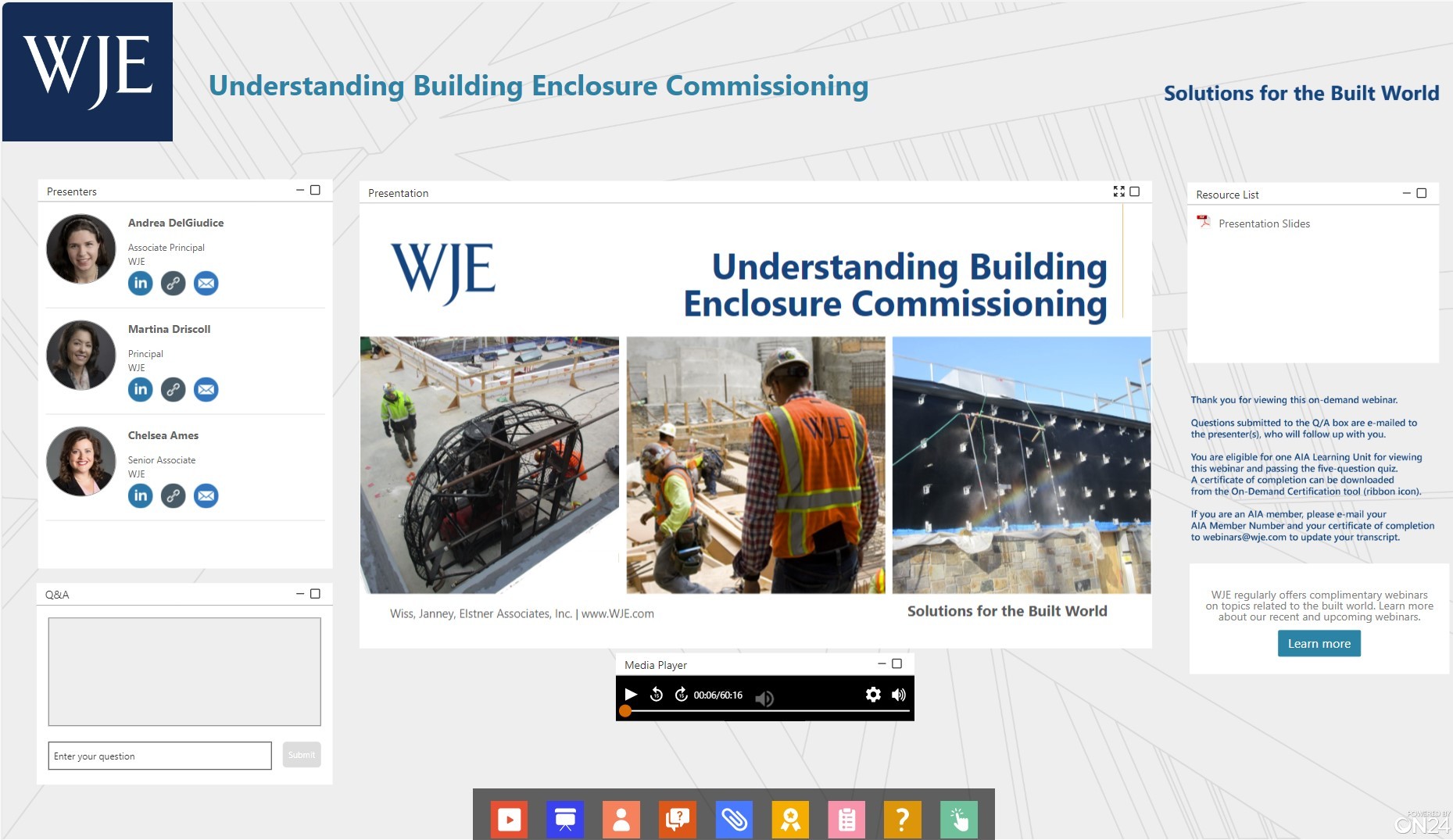
Andrea DelGiudice, Associate Principal and Unit Manager
Martina T. Driscoll, Principal and Executive Director of Corporate Communications
LIZ PIMPER
Hello everyone, and welcome to today's WJE webinar, Understanding Building Enclosure Commissioning. My name is Liz Pimper, and I'll be your moderator. During the next hour, architect Chelsea Ames, architectural engineer Andrea DelGiudice, and civil engineer Martina Driscoll will illustrate the key components of the BECx process and explain why an owner might find it valuable to implement building enclosure commissioning on a project. This presentation is copyrighted by Wiss, Janney, Elstner Associates. And now, I will turn it over to Martina to get us started. Martina.
MARTINA DRISCOLL
Thanks everyone for joining us today. Hopefully by the end of this, you'll understand a bit more about the history of BECx, the definition, why we at least think it's often worthwhile, and who should be providing this service for you or with you.
As Liz mentioned, we'll talk about some history and purpose. We'll go over the process in more detail. And Andrea will then pick it up and talk about achieving success with BECx.
Before we get started in earnest, would like to understand a bit about our audience today. So if you could use your cursor on your screen to select your background, I'll give you about seven seconds, and then we'll close the poll. Okay. Hopefully everyone's in. Give it just one more second. All right, here we go. Okay, great. And then one more here. Have any of you worked on a project that's had building enclosure commissioning as a requirement?
Okay. Getting ready to close the poll. All right. Great. Looks like we've got a good mix of people on the call, some of whom have some information on building enclosure commissioning already.
So why are we all here? Why are we even here talking about this subject? Basically, moisture is a problem in the built world, and that problem is the cause of a huge portion of construction-related damage and litigation. Some sources say 80%, some 65, some 90.
But that moisture gets through the enclosure, often at interfaces between systems where there can be a kind of no man's land of responsibility for detailing or continuity.
These two pictures show a window and a brick cavity wall interface condition. This is before and after leak investigation and repairs. Just to give a sense of how complex these details can be. These repairs were a result of a project that had a $12 million original construction cost. This resulted in a $6 million lawsuit and $1.2 million in repairs, so 10% of the original construction cost.
In addition to that, the building sector consumes a huge chunk of energy. So building energy efficient buildings and building buildings that last is important. And in our opinion, it's the essence of sustainable design, whether your building is "green" or not.
As a reaction to those building enclosure related failures, which we had historically investigated and repaired, we had clients from all parts of the team, architects, owners, general contractors. They came to us and said, "Hey, thanks for fixing that, but could you help us not do that in the future?" And that actually made a lot of sense to us and started our building enclosure consulting practice.
Just as an example, I remember one of the first calls we received was from a general contractor asking for someone to help him figure out what his glazing subcontractor was doing. He recognized he didn't know enough to call out those issues on his own, whether his sub was right or not.
On top of that, as designs have become more complex, we've seen a move towards specialization in design. And the cost of detailing all those complexities aren't typically in the job. Owners don't want to or they can't afford to pay for that level of detailing in a contract document set.
We've also noticed that along with that, there seems to be a reduction in the ability of some skilled trades to "finish" the design in the field without very prescriptive direction in the CDs and very tight quality control on site. So things that were once assumed, say putting flashings or end dams where they need to be, now they need to be carefully specified. And again, there's cost associated with that.
Expectations have also changed. The days of just accepting a building or draft building are gone. That's both due to occupant comfort expectations, but also due to code requirements.
New enclosure designs simply have less mass, so less moisture storage capacity and redundancy. They're also more airtight, and a drafty building can hide a lot of moisture related sins. But of course, at the cost of energy efficiency.
As these issues became evident, owners were asking for someone similar to that general contractor, they were asking for someone who kind of understands all this and can serve as their second set of eyes on a project to decrease the chances of those failures, and increase the chances that they get the high-performance building that they bought.
As time went on, this practice was more widely recognized. And when working for the project owner, some started calling it building enclosure commissioning. That commissioning term is a term taken from the mechanical QA process. Most of us were familiar with that.
We started to see formal RFPs for this work. Some with inconsistent scopes, some with no testing requirements at all. ASHRAE guideline zero and NIBS guideline three were out there. I think guideline three was 2005 or 2006. And they were widely referenced, but there was no minimum requirement for testing in those guidelines, and they were written in non-mandatory language.
In 2010, we started work developing a standard practice through ASTM that would include some minimum requirements in order for it to be called BECx. You could have building enclosure consultants on the job. But if you wanted to call it BECx, we thought there should be some minimum standards.
That standard was published in 2012. And at that same time, a memorandum of agreement was signed between ASTM and NIBS that migrated guideline three to ASTM as a companion guide to the standard, so that's ASTM E2947. This was followed by several other standards including ISO 21105. That was published in 2019. LEED also started mentioning BECx, I think that was version four, and now includes a reference to the ASTM standard.
So what is it? This is the definition of the process as it's stated in ASTM 2813. Functionally, it's an additional quality assurance process. The commissioning team uses methods and tools to verify that the project is achieving the owner's project requirements, the OPR, throughout the delivery of the project. And an important part of this verification is measuring and reporting through functional performance testing.
What isn't it? What is it not? Having a BECx professional on the project doesn't mean that the AOR abdicates responsibility for the building or for building the appropriate team of closure experts on their side, that they feel they need to meet their contractual requirements to the owner. For some architects, they have that in-house. For other architects, they may need to hire that in as a consult.
Also, it's not a substitute for the general contractor's quality control responsibilities. It's also not supposed to be overkill, but instead should be tailored to meet the requirements of the specific project, the client, the regulatory environment. It's also not just a set of checklists.
On that note, we recommend all checklists remain the responsibility of the general contractor and their subs, and that they can be required as project submittals like any other submittal if necessary. The BECx provider may have their own checklist as part of their practice, but it never made contractual sense to us that the owner's consultant would be required to provide those to the general contractor. So that is a change from guideline three.
Chelsea and Andrea will talk more about this in upcoming slides. And don't worry, Andrea will talk specifically about the ASTM 2813 testing matrix. I know that's a hot topic.
So why BECx? Historically, the answer has been tied to voluntary things like the owner had enclosure failures in the past, so they wanted to prevent that in the future. They're risk averse, because it's a lab or a hospital where any leak would be intolerable. Maybe they'd work successfully with a consultant and they're convinced of the value of that, or because they wanted to meet internal sustainability goals like LEED.
But sometimes, it's because I said so. Right? BECx is now required by code at a few different levels, including federal groups like the GSA and U.S. Army Corps of engineers. At the state level in several states. California has Title 42. Local levels such as New York City, Seattle, Houston.
In addition, there are sustainability-driven codes and standards such as ASHRAE 189.1 or the International Green Construction Code that have some requirements.
Washington D.C now requires BECx through one of two ways. Option one is through whole-building or compartmentalized air leakage pressurization testing. Or option two is through the ASTM E2813 process we'll be discussing further. I mean we may be a little biased, but we feel like option A, which is solely focused on air testing basically at project completion, is a bit of a holdover from a time when building enclosure commissioning was viewed like mechanical commissioning, with the enclosure as just another part of the mechanical machine to be tested and balanced.
The problem with that requirement is that it's a part of the machine with thousands of parts and hundreds of installers. And it's very hard to address if you fail. It also leaves out various other performance aspects of the enclosure, including water penetration, which we've already said is a big deal.
So based on all this, prior to me handing it off to Chelsea, which of the following do you view as the most at-fault for the need for BECx?
Okay. Well, glad to see no one thinks we don't need it. And that seems evenly split. Unbelievable. Okay, I will now hand it off to Chelsea.
CHELSEA AMES
Thanks Martina. That even split is certainly some interesting feedback on that poll. So now that Martina has introduced us to the overall purpose of building enclosure commissioning and the background on how and why BECx has evolved, I'm going to get into some more detail about what the process entails and what you can expect as an owner, architect, or contractor on a job that will have a commissioned building enclosure.
So let's start with our roadmap of the project phases. Many of you are likely familiar with the project phases shown here, although some entities might define them differently or highlight various sub-phases. The phases listed here are as defined in ASTM E2813, and as they relate to the BECx process. On the right of each phase, we have sort of the overarching goal or essence of that phase.
We're going to step through each of the main four project phases throughout this presentation. We'll note that the bidding and negotiations phase is one that has less structured tasks included. And in our experience, the project delivery method has a bigger impact on the tasks included in that particular phase.
So let's start by reviewing the tasks that are involved in the pre-design phase. Recall from that prior slide that the main goal of this phase is to define project expectations.
So during the phase, the provider will work with the owner to develop a scope and budget for the BECx process. And that scope might be determined based on the owner's risk tolerance, the anticipated complexity of the project, or if there's a regulatory requirement as Martina discussed.
The BECx plan will be prepared by the provider, which identifies systems that will be included in commissioning, which is again based on the scope requested by the owner. It will also identify roles and responsibilities as well as a contact list of all team members and the BECx schedule. The BECx plan is a living document that's updated throughout the project as details of the project are developed.
So at the pre-design phase, it may be a bit of a skeleton plan, but the intent is that it evolves along with the project. And the goal of that document is to be a resource to all parties and to help outline the process from start to finish.
A critical step in the pre-design phase is the development of the owner's project requirements or OPR, which we're going to discuss shortly in some more detail. But first, I want to mention that the ideal time to retain a BECx provider or BECxP is in pre-design. The reality is sometimes that provider is not engaged until the design phases. If you're seeking enhanced BECx per ASTM E2813, that provider should be retained no later than the start of schematic design. And if you're looking for fundamental BECx, it should be by the start of the design development phase.
The most important thing here that we want to get across is that these pre-design tasks have to occur, even if retroactively in the event that the provider is engaged late. The OPR is the most important document to develop a review shortly after engaging the BECxP, because it provides the foundation for the rest of the project.
So you might be thinking, "Chelsea, I've never had an OPR on my projects. Doesn't everybody know what's required? Aren't I already paying an architect to determine these things?" And the answer is yes, to some extent. Written or unwritten, these requirements exist. And there are some that everyone can assume. For example, we don't want water leakage, and we obviously can't tolerate the building falling down. But what about less obvious expectations?
So I want you to remember that not all enclosures are created equal. Is this a design research laboratory with stringent air leakage requirements and a demanding mechanical system that's going to put extra pressure on that enclosure? Or is it a building with a less critical enclosure system?
This is where the OPR comes in. This document defines the performance expectations for the building. And it's not a one size fits all document, although there are certainly owners that might have standard OPR documents such as institutional owners. At a minimum, the BECxP must review the OPR document. And on some projects, the OPR can actually be developed with the input of the BECxP in working sessions.
So what goes into it? The list on the right shows the major categories to consider in the development of the OPR per ASTM E2813. It's important that the requirements be documented and verifiable. So for example, rather than stating the building must be "airtight," a measurable air leakage rate should be provided.
The importance of durability is another expectation that's often assumed, but not well-defined. So here, for example, we want to ask, is the owner prepared to replace exterior sealants in 10 years or less? If not, the OPR might require that all exterior sealant joints or silicone sealant, as we know that polyurethane sealants deteriorate due to UV exposure.
It's important to discuss the expected service lifetime frames for the various enclosure systems, and to ensure that those expectations are aligned with other project goals like initial cost and maintenance.
Another example we're seeing often recently relates to sustainability and operation. If the roof will have a ballasted photovoltaic array on it, what is the anticipated service life of that array, and how does that align with the service life of the roofing? If those things don't align, should that array be ballasted, which will require disruption for re-roofing activities, or should it be elevated on dunnage for uninterrupted service?
Like the plan, the OPR is a living document that guides the remainder of the design and construction process. So if the designer construction is found to be noncompliant with the OPR, it is the owner's right to either require that that noncompliant condition be corrected or to edit the OPR accordingly, signifying a change in project expectations.
Now we're going to move forward into the design phase. The key tasks here include review of the basis of design and construction documents for conformance with the OPR. A skilled provider can also provide recommendations to improve the enclosure performance, which I'll touch more on shortly. The owner and the architect will review the comments provided by the BECxP, and determine which comments will be incorporated.
A top question we get asked by owners is, how many reviews should we include? And that's going to depend on what level of commissioning you're seeking, or if you're following any regulatory program. So it could be just one review for fundamental commissioning, or up to three for enhanced commissioning.
This is also when the BECx specification is developed, which outlines the performance metrics that must be met and the testing scope that will be implemented. Input from the owner and architect should be provided for development of that testing schedule.
And as I mentioned earlier, the provider should be engaged by design, and really the sooner the better. You can imagine how developing an OPR after design has begun might send some aspects of the design back to the drawing board, so to speak.
The BECx process requires input from the design team, and they should know that the process will be implemented when they're retained, as it takes effort and fee on their end to participate fully.
Design reviews are critical because they're the first opportunity to catch issues and resolve them before any time or money are spent in the field. In addition to verifying that the design meets the OPR, we're looking to verify that they clearly convey the design intent. This is not a box checking exercise, whereby the BECxP identifies where a detail shows pre-finished metal flashing, for example, instead of stainless steel.
The image on the right is from a recent design review of a CD set, and I want to ask what's being conveyed here, and do we think this level of information is sufficient to communicate all components necessary for this cladding and fenestration system to meet performance requirements? Will this detail get us accurate bids, or does it expose the owner to risk of change orders?
We can see here that they are buying "three lines of sealant" and we can deduce this might mean that this is a curtain wall assembly. Is the assembly thermally broken? Do we expect there to be drip edges above the openings?
Another example on the right is a roof plan, where we have parapet walls that are intersecting taller facades. This is a very common interface that gets overlooked and that's difficult to communicate in drawing sets short of isometric details.
As Martina mentioned, interfaces tend to be locations for failures and enclosures because of the challenges associated with the limitations of 2D drawings. Further material and trade interfaces are greatly affected by construction sequencing and overall project communication. At a minimum, identifying tricky interfaces and design can help.
And identifying gaps in design information or detailing issues is not meant as a criticism to the architect or designer. Even the best prepared set of CDs might have hundreds of comments from the BECxP. The goal here is a clearly conveyed quality enclosure design.
There's typically a meeting held following design reviews to step through the comments, and allow all parties an opportunity to share their thoughts and agree on which comments will be accepted. In this snip shown here from a comments log, the items in green were responses from the architect that addressed the original comment by the BECxP. Items in yellow were flagged as a discussion to be had in the design review meeting.
You can see how the owner also has a role to play in this review to verify their expectations for maintenance. The suggestion by the architect in this instance was a good one. We just needed to verify that the owner wanted windows to be interior glazed for future maintenance reasons, or if exterior glaze units proved less disruptive to their operations.
There's a saying that I've heard from Martina and Andrea, which is don't hide the ball, which means collaboration is key in this process. BECx providers should be technical experts in enclosures. And by proxy, they should be expert problem solvers when it comes to detailing enclosures and identifying potential issues upfront. A good provider can help facilitate the process to find an acceptable solution and not just identify issues. They should also be able to provide comments within the framework of the design intent that's communicated by the architect.
A good designer is open to collaboration and to modifying their detailing to meet the owner's expectation. The designer or architect, owner and BECxP all have the same common goals in this process.
So let's move forward into construction. The key tasks here include review of enclosure related submittal packages and participation in pre-installation meetings. These tasks are still quality assurance oriented. Field or laboratory mockups may be specified to help review critical details ahead of construction and to evaluate with performance testing. And the BECxP will perform construction observation site visits, and may perform or witness performance testing. BECx meetings are held throughout the phase to keep all parties apprised of the progress and action items that have been identified, where there might be non-conformance with the OPR that requires resolution.
First, let's talk about submittal reviews. I think I can speak for my colleagues when I say submittal reviews can be equal in effort to design reviews. And maybe this makes sense to some extent, because the design is not completely finished until submittals and shop drawings are prepared. So this is why clearly conveyed design intent and performance expectations are paramount.
MARTINA DRISCOLL
Chelsea, I'm not sure if you'd agree, but I think you would, that I often find that this is the hardest part of our BECx scope to define. Because the amount of that we need to allot to this scope is a function of how many submittals will be included, how complex they are, how good of a job the subcontractors and contractors do, and putting them together and reviewing them. I know sometimes, we'll stipulate that we'll focus much of our effort on shop drawings, for example, to try to control the cost of this phase.
CHELSEA AMES
Yeah, I agree Martina. There's a lot of variability here, and shop drawings do tend to have the most technical content that benefits from an extra review.
Reviews by the BECxP are typically performed concurrent with the architect, so it doesn't replace the architect's role. And then the BECxP's comments are submitted to the architect and the owner for review and final acceptance or rejection.
In addition to conformance with design documents and the OPR, one major thing that we're looking for is the overlap between trades. So on the screen is an example where the curtain wall shop drawings and the metal panel shop drawings reference one another, but showed some conflicting sequencing requirements.
So the metal panel shops on the right require that the soffit panels be installed before the curtain wall for the anchorage to be completed as detailed. It's the responsibility of a GC or prime contractors to manage this condition for coordination, but BECx providers and the architect can also help identify items requiring coordination.
Construction observation site visits are performed throughout enclosure construction, to verify that the as-built construction is meeting the intent of the design documents and the improved submittals. It's also a chance to troubleshoot issues in the field and get them resolved efficiently.
The contractor should plan to walk the site with the provider to review their observations in person and ideally the owner, and even the architect can attend these site visits as well. Observations are documented in a site visitor report, and nonconforming items are typically documented in an action item log. The responsible party for the nonconforming item then provides a written response as to how the issues will be resolved, and they'll document that resolution. Sometimes, there are items identified that might require input from the owner or architect, so you can see where having them in the field is helpful.
We often get asked how many site visits are needed. And of course, the answer is it depends. The goal here I typically say is that we'll want to witness the initial installation of all major enclosure systems. So if there's anything that's nonconforming, we can address those items early and not be repeating issues. The project example on the screen for example had 15 site visits, most of which were performed over a 12-month period. And the number and timing of the site visits should be coordinated with the enclosure construction schedule. So you can imagine that it varies quite a bit.
During site visit number two on this project, a non-conforming issue was identified with the air barrier detailing, and that resulted in a small amount of brick having to be removed for correction of the concealed work. So on the photo on the right, you can see the inside corner was not detailed with the spray applied air barrier. We also had holidays at brick ties, and some areas of thin coatings.
The next week, we came back for site visit number three, in which the brick had been removed to expose the wall, and the air barrier detailing was completed as required by the manufacturer. And confirmed with field testing that it passed the air and filtrating test required of it, and then the project moved forward and the brick was installed.
You can see that if the early site visit hadn't been completed, this issue would not have been identified until more brick was installed due to the sequencing of this particular project where the trades were close behind one another. And if it had been identified at all, that is. This is a laboratory building where air leakage performance was a primary performance objective.
Going back to the roof plan that we often flag, this is a case where we identified it in shop drawings, design and shop drawings. And here we are on construction observation site visit. And in this case, the sequencing we recommended was achieved. So you can see how the mason left brick out for completion of a saddle flashing at that interface, which is not yet complete in this photo. It shows a successful coordination and detailing from design into submittal reviews, and into construction.
Here's a not so successful example, where despite communication by the architect and the BECxP in design and submittal reviews, the contractor was not responsive to that coordination. And the brick in this case was completed through the interface, where the roofing membrane that came over the parapet as shown in the image on the left needed to transition back at the plane of the air barrier.
The roofing installer left the membrane in this condition as shown on the left for months before the substantial completion site visit, and this condition was identified in numerous site visits over that period, again without correction.
Performance testing of the roofing assembly on that project identified a large area of wet insulation starting at that corner and extending well into the field of the roof, as indicated in blue on the plan. This condition required that a portion of the roofing be replaced before the building was ever opened.
So in the end, the owner did get the roof that met their expectations as outlined in the OPR. But still, more coordination and responsiveness from the contractor could have made this more successful and less costly to the construction team.
One way we aim to identify performance deficiencies early is through performance testing. Testing is specified in the matrix, in the BECx specification section. And the goal is to test early in the process so that any issues with installation can be corrected and addressed moving forward. We want to avoid anyone from having to do substantial rework as was shown earlier. Testing allows us to verify that the measurable requirements of the OPR are being met.
So now, I'm going to ask Andrea to talk about selection of performance testing requirements, and how we determine what to include in the BECx spec.
ANDREA DELGIUDICE
Thanks, Chelsea. Let's take a quick click at what ASTM says, and this is the table laid out for you. I could certainly imagine folks asking, "Is this five pages of testing to death?" I was not around at the conception of the standard, but Martina, you were. Can you talk a little bit about how we came up with this?
MARTINA DRISCOLL
Sure. Yeah. We had and continue to have many of the consulting players across the industry in that ASTM group. But we also had architects, owners, subcontractors in the room. And this standard was written based on our collective experience in terms of what we were actually doing on projects and the tests that we would run.
Now that said, and I think you're going to talk about this, we fully recognize that this table is confusing, and that there's a wide misconception about what is and is not required. And I know that the work group is diligently working to clean that up at ASTM, and we'll reissue this to more clearly designate mandatory tests.
ANDREA DELGIUDICE
Thanks Martina. That being said, your provider should be able to interpret this table and take it from this to something that looks like this. And some of this might even be familiar to you, even for those of you who said you haven't worked on a BECx job. Because as Martina mentioned, these are very common quality assurance tests that we would run for the enclosure, not always only for BECx.
Now we do think of BECx... Excuse me, the testing happening in the construction period. It does. But I'm going to talk a little bit about how we get this paired down to the right list, and that really needs to start happening during pre-design at the OPR.
So you can see hopefully now, that the table doesn't mean that if you commit to this process, you're going to be stuck spending money on testing things that you don't care about because they're in the table. I've gone ahead and highlighted two pieces of information that are included in the introductory paragraph to the testing table in E2813 that kind of explain how this works.
So the first piece here clarifies that testing is going to be defined by the architect of record, the designer, and the BECx provider in their team, and that it's going to be a function of the priorities established in the OPR. The task group then goes on to give an example of this, talking about extraneous air leakage. And I want to dig into that just a minute because it really explains how you should think about testing.
So the intent of this example is to get to something where we can kind of talk through this, where we clearly don't care about some measurable performance criteria that is typically very important. So we selected air leakage. Generally very important in a modern building.
But what if we wanted to commission an open air pavilion? Well, then we can all agree we don't care about air leakage. So the owner doesn't care about air leakage, which means the provider doesn't put it in the OPR. The designer then doesn't specify it, and it is not getting tested. And if something misses the mark in that feedback loop, the provider should flag it for the team.
So the bottom line is that the intent of testing is to evaluate performance metrics the owner cares about but cannot otherwise be evaluated. So I could definitely tell occasionally during a site visit. If there's a giant hole in a window, I'm going to see it. But if I really need to understand the performance of all the windows that don't have giant holes in them, I'm going to need to test them to see if they can meet their specified rating. So meaning the owner got the performance that they're paying for. At the end of the day though, testing, everything in BECx needs to tie back to the OPR.
So let's go ahead and close out our discussion on process. Let's say you've even completed the entire construction process, including implementing some very valuable testing that is aligned with your OPR. And you're coming to the time for the owner to take over the building. Everyone else, designer and contractor is closing out at this point, and so is the BECx provider in their group. They're going to be working on their own closeout tasks, and typically the process formally ends at the pre-warranty site visit. Although we can extend our work for the owner farther into service life if that's desired.
So the ten-month site visit noted here is a lead requirement if you are looking to get lead points for BECx. It's also not a bad rule of thumb. You'd like to finish that visit and any required follow-up before the one-year mark.
The provider is going to want to walk the building, or their qualified team member is going to want to walk the building with folks who are knowledgeable about the enclosure, performance. And not just maybe where leaks might be occurring, but also someone who might be aware of what's going on with the mechanical systems. Ideally, even the mechanical commissioning specialist. There may be issues that overlap between the two systems. And then ultimately, we'll provide a final report.
We know why you might want to do BECx. We generally know what you should expect to see throughout the process. At a high level, what is the secret sauce to really making this a success?
First, hire a qualified person, hire the right person. We believe that every team needs a provider, and the ASTM standard states that. So this is a person in responsible charge. Now this person should have certain competencies, or where they have blind spots or misses, they should assemble a team that ultimately meets all of this criteria.
In addition, the team needs to be assembled to make sure that we have continuity of competency across all phases. So for example, your field team member might not need to be able to take the lead on a design review yet, but they do need to have all the knowledge in place that they need to execute field work. This just doesn't turn into a list of checklists. There's always a more dynamic knowledge needed throughout all of the phases. Frankly, particularly on the field.
ASTM E2813 provides these four core competencies which we found to bear out. So you can see that building a material science along with performance test standards and methodology are the meat of our technical expertise, and I think Chelsea did a great job showing how a provider with good depth in those areas can be a huge asset to the entire team.
Understanding procurement and project delivery is just crucial to designing the appropriate strategy and making sure that actually all of the things in the OPR are going to end up in the documents, along with the construction documents and construction administration process. That's all the how everything gets in there and delivered on the building.
Another thing you might be wondering is, who should the provider work for? We've worked for all parties, and ASTM is intentionally silent on this in order to leave that determination up to the owner. That said, other standards including some that reference ASTM are extremely specific about this. So your provider should really walk you through what needs to happen there.
Regardless of who's hired us though, this process is intended for the benefit of the owner, and the owner needs to remain at the center of it, as does the ability to communicate directly with the owner. So the BECx provider and the owner have to be able to talk unencumbered.
Another common arrangement is for us to be retained under a mechanical provider. And in that case, the thing to be aware of is that our involvement is going to be staggered from and slightly different from theirs. So the construction schedules for the installed work are not the same. And while the processes are analogous, they are not entirely the same.
Regardless of the credentials I'm about to talk about, I think you can see that your provider needs to have those competencies either themselves or amongst a team that they've assembled.
Now, there are credentials that you may see. Many providers are licensed architects or engineers, with significant hands-on experience in both enclosures and building enclosure commissioning. Some providers have certificates or certifications, either instead of or an addition to their professional licensure. And this is actually where things can get a bit confusing.
So some of these credentials are for more general commissioning, that's great. But something specialized in building enclosure commissioning is going to be more relevant. Then there are education-based BECx certificates, which have been around for a while and are a great place to start. These programs are generally taught by highly qualified building enclosure commissioning professionals. And if a professional is deciding to seek an ISO accreditation, they can be a great learning platform. Although they can't teach to the test, and you'll see why that's important in a minute.
So ISO accredited programs are newer to BECx. And when I say that, I mean the ISO 1724 accredited personnel certification program. There's some really specific things that go along with that. IBEC rolled out the first of these programs a few years ago, but if the MEPCx space is any indication, we may see more in the future.
So the thing that's different here is that this program includes rigor beyond what is required in an education based certificate. Chiefly, there's a separation between education for the test and the development and administration of the test, and there's also continuing education requirements to maintain the certification. In a completely different vein, there are multiple options for education or accreditation for laboratories and technologists performing testing that you might seek, and that's something your provider can advise you on.
So you can see that there are intangible and tangible qualifications for your provider, and it's really important to have all of these come together for there to really get to the secret sauce. The provider having a deep understanding of both BECx, not just overall CX, and the building enclosure, technical aspects of the job, as well as being a great communicator who provides timely input and is a collaborative partner is really the key.
I also find that having investigative experience has been really valuable to me. The design team and the construction team are focused on a lot of things. I get to just focus on the enclosure. And of the team, I'm going to be the person who's most likely to have gotten to see a flashing slump into the wall, which is the top photo here, or systematic sealant mist at the top edge of the slab edge cover between the slab edge and the cover itself, leading to air and water leakage, which is the bottom photo here.
And the teams that I work on don't just want to hear me say, "Well, this might happen." They want to hear about what I've really seen in real, life and that really helps us have a better conversation about the decisions we're going to make on this building. Because no one on the team, design or construction, or the owner wants to deal with callbacks. So ultimately, I think that that helps me to be an even better collaborative partner for my teams. So achieving success, you've got a great provider, awesome start. Now everyone has a role to play.
Everyone needs to engage, collaborate, and communicate. If we haven't said those words enough yet, the entire team is working towards the same goal, and this is just one tool for the team. So that the only calls back we have are referrals for another project.
First, let's talk about the owner's role. Everyone has specialized knowledge they bring to the team, especially the owner. You're the only one who knows what you want, so figure it out and let everyone know through the OPR process. Engage with the process at all phases. There's no time where you can be hands off and delegate, no matter how great of a team you've assembled. Even if you've hired the BECx provider through another entity like the architect, please remember to stay engaged. And remember that your provider's only authority is what you're willing to buy into and enforce.
The architect. Think holistically, engage with the building enclosure commissioning group, and leverage their expertise. Ask questions and share your concerns and point of view. Make sure that you have the scope and schedule to engage with the BECx, if the best provider still needs you to fully review and engage with our comments and recommendations at all phases as the designer. And actually, another key point for the owner, a key thing you can make sure happens is make sure that everyone has this in their scope so that everyone is prepared to engage and set up for success.
For the contractor, make sure the schedule includes building enclosure commissioning, which is going to happen throughout the entire project. If you haven't picked that up from Chelsea's slides earlier, it's not just going to be testing at the end. Get it in your scope to engage and stay engaged. Even the best provider, the job still needs your QA and QC.
Identify someone to be the main point of contact for the enclosure so they can coordinate everything, including bringing forward any lessons learned from any part of the process to the rest of the team.
What does it look like when we achieve success? Reduce risk for everyone and limiting rework. Performance assurance of the installed enclosure assembly, which also supports energy efficiency and sustainability goals, measured achievement of the owner's performance and durability goals, and better owner resources for enclosure and maintenance operations.
And when should you do this? Well, in most cases, a project will benefit from well-executed building enclosure commissioning. But Martina, Chelsea, and I all agree that not all buildings need it. There are absolutely project teams out there delivering without it. Maybe they have in-house specialists, maybe they do a lot of repetition. Maybe they just need a little bit of quality assurance plus to get to where they need to be.
But we also obviously think you should think about it. Like Martina said, after experiencing the pain and expense of failure, this is when we see everybody, owners, contractors, designers fully embrace the process.
So if you've never been through that and you aren't embracing it because of failure, maybe you're thinking about this for a project with low risk tolerance, mission-critical, expensive insights, or something new. Either a completely new thing to the market or something new to you.
You may be here because you're thinking this is required by code. Being forced to do something isn't the best starting position for success. But if that's how you come to building enclosure commissioning, I think you have a choice. You can push it to the side, you can make it a checkbox activity, or you can embrace it and you can really reap the benefits.
So if this is so valuable, why isn't every building enclosure commissioned? I think the biggest factor here is the perception, I would say misperception that it costs too much or it slows the job down. Obviously, people experiencing failure, embracing it speaks volumes, but I get it. Initial costs can seem high.
We've taken a look at our costs across time and project types, and what we found is that they tend to be about 1% of total construction costs, although even less for a building with expensive inside. So if you're thinking a hospital or a laboratory, we're looking at about 0.5%. When you compare that to the 10% of the original construction costs for repairs that Martina spoke about earlier, in this photo in the center, I think that's just good value. We'll be going through your questions now. Liz, what do we have?
LIZ PIMPER
All right. Thank you very much Andrea. And Martina and Chelsea, that was a great presentation. We're now going to turn it over to questions. We have quite a few that have come into the inbox, and we won't be able to get to all of them today. We're going to get through as many as we can. And if we don't get to yours, one of the presenters will follow up with you afterward. Okay. Let's take our first question. How much design do you typically see happening in the shop drawings, and how does that affect the BECx process in your experience?
ANDREA DELGIUDICE
I'll take that one. So I think it really depends on the nature of the project. Sometimes you have a specialty system, like a complex curtain wall, or skylight system. And in that case, there's an awful lot of design that's still happening, and that's appropriate because the subcontractor is really part of the design team.
Sometimes, things are really well-defined up front. We have a basis of design and we get that basis of design, and so there's a lot less happening. A lot of times, it's a middle ground. There are things changing. We've specified one window and we're getting another, and you're sort of in the middle.
LIZ PIMPER
All right. Our next question, what kind of performance might an owner require for their projects? Assuming the owner is not a BECx expert, how does the owner understand what those requirements are or what they should expect?
MARTINA DRISCOLL
I'll take this one. It's Martina. There's a lot of layers to that. I think as we mentioned, there are some owners that are meeting say university design guidelines. And so there are basis of design products at least that have been selected by a group, that they've used successfully. Those basis of design products bring in a lot of performance requirements along with them. If they want to meet lead, then that brings in another set of requirements.
But part of that, and I get the question. It's hard. And I think part of that was why Chelsea mentioned that bringing somebody in early, it can be your architect as well. But talking through those decisions with someone who is savvy can help.
A lot of that discussion that most might be familiar with are warranty discussions, which is kind of a performance requirement that we often see some misalignment between what the owner thought they were getting and what they get. So that is another thing that we look at, is what are the warranty requirements, and are they in line with owner expectation? Sorry, there's not really a short answer to that, but I hope that helps.
LIZ PIMPER
Thanks Martina.
CHELSEA AMES
I'll also just add on that in the instance where an owner doesn't know exactly what they're looking for or what they need, the BECx provider can help facilitate development of the OPR and bring their expertise to help guide the owner.
LIZ PIMPER
Okay. Our next question. Does WJE prefer that BECx be hired directly by the building owner or by the architect of record?
ANDREA DELGIUDICE
I don't know that we have... Well, as we said in the presentation, it's absolutely paramount that the BECx be able to speak frankly with the owner. And so when we're hired by another entity, we really need to make sure that everyone is on board with that. And so I guess in that sense, our preference would be the owner, but we would prefer that we get onto the project if it's going to benefit the project. And sometimes through the contracting process, we do work for other parties, and we've absolutely been able to make that successful.
MARTINA DRISCOLL
I would say too, in the purest sense, we're hired by the owner as an independent third party. But to Andrea's point, we have worked successfully. You just have to be careful that you are in fact calling balls and strikes and there is no conflict.
But that was a discussion that was pretty heated during the development of the ASTM standard, where people were very hesitant to get in between the contracting process between an owner and the way they would want to contract their work. For example, if they preferred that the architect hold the contracts for all of these things, there was a strong consensus in that group that ASTM didn't want to get in the middle of that. I think some of the other groups we mentioned, I think Andrea mentioned are very clear that it's the owner.
ANDREA DELGIUDICE
Sometimes it's also the architect. So just something to be aware of if you... Just make sure you're talking about that. In those standards. Martina's comment stands, and some of the standards that it's the architect.
MARTINA DRISCOLL
Yeah.
LIZ PIMPER
Okay. Our next question. How can subcontractors be notified that a BECx process is in place on a building before bids are submitted? It certainly does cost more for the trade partners, so how can they be "warned" that this kind of thing is going to happen?
CHELSEA AMES
Yeah, I can answer that. This is Chelsea. This is where the early engagement of the provider is important. And development, they should be developing a BECx specification section that gets put into the architect's specifications or project manual. And that's going to outline what the requirements will be for the various systems.
That's the most effective way to identify that BECx is happening. That specification section will tell a contractor what performance tests are going to be required.
And then in addition to just writing that specification section, one thing that we'll look for during the design review is that relevant other technical specifications reference the BECx specification. So in the related sections portion, part one of the technical specs, that BECx specification section should be listed so that nobody misses that this process is going to be occurring.
LIZ PIMPER
Okay. Our next question. How did you deal with BECx scope that clearly came from when the commissioning did not include the enclosure, and it can't be done as intended.
ANDREA DELGIUDICE
This is a great question. This does happen less than it used to, but it still happens. So I believe the question is asking how do we handle when an RFP includes a commissioning scope that is written for an MEP and not for a building enclosure provider.
What we'll generally do is reach out to the owner or the solicitor of the RFP, and we will walk them through what the analogous appropriate process is. And that crosswalk is something we're very used to doing.
There is a crosswalk for almost everything. I've gotten relatively fluent at it. But for things where they're requesting something that just doesn't make sense, it's kind of nice actually to be able to tell them, "We're going to do this, but you don't even need to do that. You don't need to pay for it." So the crosswalk process is what we rely on there.
LIZ PIMPER
All right. Our next question, what is the recommendation regarding mockups in the field with respect to the BECx process? Is that typically called out explicitly in the scope?
MARTINA DRISCOLL
I'll be happy to take that one. We are very pro-mockup, and typically recommend it. It is a requirement of ASTM E2813, but only as a on building first installation. You can do that at minimum and still meet the standard.
Laboratory mockups are not a requirement at any level, but they can be recommended by your provider. We like to see off building on-site mockups at least. We find them to be such great bang for your buck. You learn a lot. And if you can get them done before, say fenestration is in production, we have caught major issues with the assembly or the interface detailing that were addressed prior to everything being ordered. So that's a great question, and I definitely think we explicitly recommend it as part of the commissioning process.
LIZ PIMPER
All right. We've got time for one more question. What is the role of BECx in a remediation project?
ANDREA DELGIUDICE
This is a great question, and I think that the question is asking, this is either a repair down the line or you didn't have BECx before. If you're talking about doing a repair on an existing building that includes the enclosure, you can implement the same process. The ability to do say an on-site off-wall mockup might be dependent on what your site looks like, or there may be times where you actually really need to do those types of mockups on a portion of the existing building, because you need to understand what's happening on the existing building. But this process can absolutely be applied to a repair project. And in fact, we have done so.
LIZ PIMPER
All right. Thanks Andrea. Thank you Martina and Chelsea. As I said before, that was a really excellent presentation. Thank you all for joining us. We hope it was educational, and we hope you have a great rest of the day.
RELATED INFORMATION
-
 Discussion of BECx process, tasks, and project responsibilities MORE >Webinars | Building Enclosure Commissioning: Improving Performance and Managing Risk
 -
 Organize and analyze information about your roofing systems so that future maintenance and... MORE >Webinars | Avoiding the Unexpected: Roofing Asset Management Fundamentals
 -
 An overview of the existing building code evolution and application of today’s IEBC provisions MORE >Webinars | Applying the Code to Existing Buildings
 -
 Martina T. Driscoll, Principal and Executive Director of Corporate CommunicationsWJE Washington, D.C. MORE >People | Martina T. Driscoll, Principal and Executive Director of Corporate Communications