

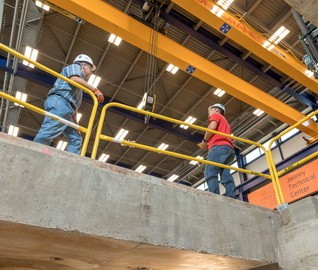
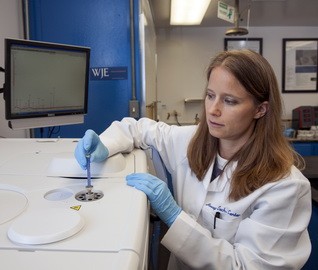



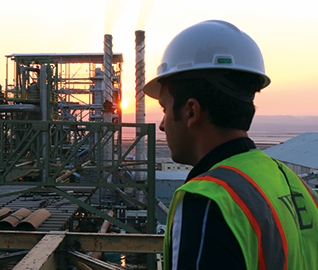



Maintaining the integrity of both mechanical assets and civil infrastructure is critical in the process industries. Often the primary concern for industry operators is the performance of their mechanical systems, while maintenance of the underlying civil infrastructure is deprioritized. By utilizing a comprehensive assessment approach that integrates operational concerns, mechanical maintenance, structural integrity, and desired service life, a more holistic repair approach can be developed to address both typical and atypical distress.
In this webinar, structural engineer Katelyn Low and mechanical engineer Scott Bouse discuss common causes of deterioration in process industry assets and the advantages of multidisciplinary assessment and repair approaches. Through case studies, they address typical challenges with repairs and strategies to extend the service life of your assets.
By the end of the webinar, you will be able to:
- Identify common causes of deterioration in process industry structures
- Explain how assessments can limit operational challenges with repairs
- Describe the challenges associated with structural repairs to large mechanical components
- Summarize repair approaches that are both effective and cost-conscious
more to learn
View this webinar in our interactive audience console to earn 1 AIA HSW learning unit, access related resources, submit questions to the presenters, and download a certificate of completion.

Katelyn S. Low, Senior Associate and Unit Manager
Liz Pimper
Hello and welcome to today's WJE Webinar, An Integrated Approach to Repairs and Maintenance in the Process Industry. My name is Liz Pimper and I will be your moderator during the next hour, structural engineer Katelyn Low and mechanical engineer Scott Bouse, will discuss common causes of deterioration in process industry assets and the advantages of multidisciplinary assessment and repair approaches. This presentation is copyrighted by Wiss Janney Elstner Associates, and now I will turn it over to Scott to get us started, Scott.
Scott Bouse
Thank you, Liz. Well, let's get started. Our learning objectives today for those of you in the A I A group, are going to be to identify some of the common causes of deterioration that we see in process industry structures. Explain how assessments can limit some of the operational challenges that we see with repairs, describe those challenges associated with those repairs, and then summarize the kind of approaches that we can use to be both effective and cost conscious. So to do that, we're going to go through a short summary list of the common causes of deterioration that we see in these things, some of the challenges that we see in making these repairs. We've got a couple of case studies that my colleague Katelyn will take us through, and then toward the end we'll discuss some of the proactive and reactive strategies that you might want to employ looking after these structures.
So we wanted to start with discussing a term that might be new to some of the members of our audience. Within WJE, we have several different civil infrastructure initiatives, and the term process industries is a term that we use internally as kind of a catchall term to describe the refinery, chemical, petrochemical, liquids and gas terminals. Really anything that's job is to move fluids around and maybe convert them from one thing to another. And we recognize that the needs of these industries are somewhat different from say, the nuclear industry, municipal wastewater and the like. And so specialists like Katelyn and I tend to focus on these practice areas that are a little more chemical or refining industrial, but whether that's TrueView or not, regardless of where we practice, it's sometimes easy for us to focus on whatever assets are in our task list. I certainly do that looking at pressure equipment and piping quite a bit more than structures, but that means that a lot of us tend to forget about items outside our scope. That's something you walk past every day, and I want to take a moment to remind the entire audience at an industrial facility includes every single constructed item that exists inside the fence. Piping and pressure vessels sure tend to get a lot of attention in my world, but the structures that support those are no less important.
Sorry. And so I wanted to talk a little bit more about how the folks in the process industries manage assets, and we use different names for this in different regions of the country. Different facilities sometimes have different names for everything, but really we're talking about one basic thought pattern if it's mechanical, civil, structural, et cetera. And that is we do our best to observe and predict the likely rate of damage or deterioration in some asset, whether that be piping or steel. We try to do that by surveillance maybe or some sort of mathematical modeling. As you see here on screen, we're generally looking towards some sort of end of life criteria that we're trying to protect ourselves against. And along the way, we have various interventions that come up to be available for us. Some are like this blue dotted line or complete rebuild of an asset.
We're resetting that damage state to zero, and in other cases we may be throwing a coat of paint on or some sort of resurfacing that provides a new latency period. But really the logic is the same between pressure vessels, concrete and steel, but where the differences come in are going to be the rate of deterioration that we see. Process pressurized equipment can sometimes reach end of life very quickly. We've certainly got clients that need to go do preventative maintenance on their equipment every one or two or three years. More commonly it's five. And structural assets will typically have lives that are quite a bit longer than that, sometimes 40, 60, a hundred years of expected life at the time that they're built. So the degradation mechanisms typically reflect that longer life as well. However, when we are talking about repairs in the process industries, it's a lot of times difficult to avoid discussing turnarounds.
For those of you who are not familiar, turnarounds are large scale maintenance efforts that really in terms of cost to treasure and time are kept intentionally short, and we see a month as a pretty common duration to get a piece of equipment shut down, cleaned out, inspected, and put back together. And as we've discussed, concrete tends to be a fairly slowly degrading asset. That means it may not need that sort of frequent intervention, but it also pretty slow to get rebuilt if the rebuild becomes necessary. And that sets up some competing priorities. Infrastructure does take time to build, and people in process equipment really can't be where there's not a structure that's going to be there to support them. So a lot of times putting large structural or concrete rebuilds into these process turnarounds can add a lot of cost and complexity. So much so that we've seen clients delay or even totally cancel jobs just on the basis of the civil infrastructure costs.
And so if your asset doesn't make the cut for a turnaround activity, where is that going to leave us? So most of our facilities in this sphere that we're talking about really were constructed between the era about 1940 to about 1980. And so this is a chart of the refining capacity that we had. This is crude oil refining by the way, chart of the refining capacity that we had. And at the end of World War ii, the United States could process around 8 million barrels a day of crude oil, and by the time we reached 1980, our total capacity was 18 million. That came from, again, the post-war expansion, cold war and the like. But what we have to remember is some of these assets, while they may degrade relatively slowly, they've also been in service for quite some time. World War II era facilities, for example, are reaching 80 years old, and so we kind of have this interesting feature where you have an asset with a long expected life that has seen a long life.
And so we need to be cognizant of that as we go forward. Sometimes updates in loads, changes in the facility that we need to do to perform the economic function of the facility, might add load or change some environment for the structure and bring us to a different kind of damage severity state. In the pressurized world, we tend to call that thought process fitness for service, and we have a term for that on the civil infrastructure side as well. It's called service life or service life modeling. So let's talk a little bit more about the damage mechanisms that can affect structural steel and concrete. And then after that we'll turn it over to my colleague, Katelyn. So on the concrete side specifically, and this really is specific to concrete, there are a number of material degradation mechanisms that can occur just because concrete is a reacted product, right?
We mix a bunch of things together, we place them where we need them, and then that reaction progresses. And so things like delayed ettringite formation or alkali silica reaction carbonation, these are actually chemical processes that take place and degrade the material over time. And then you have things like freeze-thaw damage and cracking from the thermal expansion of hydration when the concrete is placed. Then more commonly to structural steel and concrete both you can have distress that's load induced. Things like overload, impact vibration, these things are really universal to our structures. And then specific to process industries, we have some exposures. Now chlorides are really kind of everywhere in the world, but we've seen some small acid leaks. Damage to structural steel or the protective coating on steel H2S can do some interesting things to steel and concrete. And then we have, as we'll see a little bit later, exposure to high temperature fire and steam that can sometimes give our infrastructure some challenges.
So when a structure does have deterioration, whether that's noticeable or not, and in this example I'm using a small concrete fireproofing system, a lot of times we can guess what kind of effect that that's going to have on our system. In this case, we wouldn't expect a kind of fire rating that you might otherwise want. Certainly not the fire rating that you had in mind when you wanted to put this in place, but it's still holding up the structure and the equipment that it needs to hold up. And so in this case, the criticality of this is largely tied to an overall risk tolerance within the unit. Now, you might still have hidden damage like corrosion under fireproofing for example, but in this case, you're expecting the steel to last at least as long as the pressure equipment that it supports. And beyond that, whether deterioration is a nuisance or safety critical is really a question of what the structural engineers call the demand to capacity ratio for any given circumstance.
In other words, you need to do some sort of assessment to understand whether a little degradation is severe or might be tolerable for a very long time. And so for those in our audience that aren't fixed equipment specialists that are, I'm sorry, are fixed equipment specialists structures tend to have quite a bit more redundancy than pressure equipment. And because of that, sometimes the consequence of a failed steel member might be settlement of load from one point to another where a failed pipe might be immediately noticed. So how do you prioritize which assets are going to get your time, your attention, your money when there's such a varying degree of time, time to degrade and redundancy in the structure? And that brings us to a very common theme in the process industries, and this is the ever present risk matrix for us. Every industrial site we work with has their own particular spin on this chart, but the underlying themes really are the same.
We do not like high likelihood events unless they're benign and we certainly don't like catastrophic events unless they are exceedingly unlikely. Nearly every asset, every damage mechanism that that asset can undergo can find a place on this chart. And as responsible asset managers understanding that we don't want to spend a lot of time and money on low risk, low criticality items, we want to put our money, we want to put our time where it's going to have the greatest impact to the overall risk to the business. Sometimes the best course of action might be an analysis to really hone in on the likelihood of some failure occurring or maybe get a more accurate understanding of the consequence of that asset will fail. We have a case study of that coming up and other times it may be the best spent dollar just to go ahead and recognize that you're in an orange zone here and we need to just go ahead and mitigate that. And whether your facility needs to be proactive or reactive in response to these particular damage mechanisms really does come down to the particulars. To talk a little bit more about some of these particulars, my colleague Katelyn has joined us to demonstrate a couple of assessment techniques and give case studies. Thank you, Kate.
Katelyn Low
Thanks Scott. So what does honing in on the likelihood or gaining more understanding of the consequence really entail when we're talking about it from the structural perspective? More often than not, that comes from a better understanding of the structure and what information we need to help you make an informed asset management decision. It really starts with understanding what are the project goals, you know your assets best, and so understanding the reason for the project initiation and the project goals helps us really guide the direction and the precision of the assessment that's necessary. Are we talking about long-term maintenance? Are we talking about a post-event assessment? We looking to change the use? Is it a newer structure and we see some damage that we're not sure what's going on? What are we trying to understand as part of this project and what's the likely consequence associated with that?
Then we might need to understand what are the operational and safety concerns? Can this be done outside of a turnaround or do we only have access to do an assessment during a turnaround if we think there's potential high consequence of an event? Based on our discussions with you, there's obviously tremendous value in doing an assessment outside of a turnaround such that you can incorporate potentially some of the repair work during your upcoming turnaround. We also need to understand what are the loads that we're talking about? What's the magnitude of loads on this type of structure? What's the equipment? Will it stay in operation? How frequently is it an operation? If we're talking about live loads from the access, how often are people accessing in and around the structure? And all of those questions will really feed into what type of assessment is necessary. Is a visual assessment going to give us the information that we can make an informed decision for you?
Is it an obvious condition? Do we think we can understand the extent of the distress from visual and maybe we don't need to know what caused it or maybe it's really obvious what caused it and so maybe a visual is enough. So really then we need to ask ourselves what's the question that we need to answer? Is the question, is it safe now? Is it how do we fix it temporarily or how do we fix it long term if we're going to fix it or if we're not going to fix it, how long is it going to last? And then maybe it's, Hey, how can we prevent this in the future? We see a systemic issue or Hey, we've had this come up on a few different situations, so how can we prevent this from happening further down the line?
They're the answer to the question might require just a simple evaluation or it may require an in-depth understanding of the structure in order to answer. So to understand what's going on, we might need to know certain things about the structure that we can't really ascertain from a visual inspection alone. Some examples of this might be, Hey, we don't have any existing drawings, so we need to know the as-built configuration or the geometry, or maybe we need to have a better understanding of the steel or the concrete strength. Scott mentioned earlier some of the common causes of distress and steel structures and some of those require in-depth investigation to truly understand examples would be how pervasive corrosion and reinforced concrete might be, what's causing the distress if it's not readily apparent, how far does material degradation extent, we may also need to perform a detailed analysis utilizing the results of some of these in-depth assessments to determine what truly is the effect of the degradation on the structural capacity.
So with the goals in mind of what are we trying to determine and what's the consequence of an event, we can really help you fine tune what's the investigation level necessary to get the right level of confidence required for the job. We can work with you to inform you on what is the value that you get as part of this additional assessment, and then how can it be used in your asset management program. One other thing that I'd just like to mention is it's important to note that sometimes this additional investigation might also show you, Hey, we have reserve capacity here. The structure might be adequate as is and even might last this way for the intended end of service. So getting a better level of understanding of what's going on in the structure might actually save you from doing repairs that weren't necessary. So now I'll just talk a little bit more in depth on some of these different types of assessment.
The first is non-destructive evaluation. You may need to get some information about the structure that you don't have available in order to properly analyze the structure. We kind of need to understand the as-built configuration and we might not have existing drawings or we have existing drawings of the structure, but that's not really what's out there right now, right? We've had some additions, there have been some repairs, some modifications, so we might need to go out there and do some non-destructive evaluation to get the information that we need, such as reinforcing bar size, spacing, cover depths. We might also maybe in newer construction be aware of some internal defects in reinforced concrete and we don't really know the extent of them or the potential effect that they have on the structural capacity. So we might need to utilize something like non-destructive evaluation to understand the extents of voids or distress or cracks. When I say non-destructive evaluation, I'm sure you're all familiar with it as it relates to steel and equipment assessments, but they can be really useful when we talk about concrete structures and the slide here just shows a few of the ones that we typically utilize, but there's a whole slew of different non-destructive evaluation techniques that can really tell us a lot of information often while a structure is still in operation to give us the level of confidence that we might need in order to develop a repair consistent with the goals of the project.
We may also have a known exposure or evidence of severe corrosion, but we might not know how pervasive the issue is in steel structures. It's generally easy to quantify and visually assess the extent of section loss, but in reinforced concrete it might not be so obvious. Scott mentioned earlier, deterioration may take years to manifest, and so we might need to utilize something like half cell potential or corrosion rate measurements to get a true understanding of the extent of distress in reinforced concrete element. The best example of this that I can kind of give you to understand when we're talking about reinforced concrete is chlorides. Like Scott mentioned, chlorides are everywhere. So this is a pretty common issue, but when we talk about chloride ingress, we have a reinforced concrete element, we have a chloride exposure, and as those chlorides migrate to the level of the reinforcing steel, we get depassivation of the reinforcing steel, which provides a buildup of corrosion product and that induces tensile stresses in the concrete and it causes cracks as we get additional buildup of corrosion product, the cracks continue and propagate to the surface of the concrete, and that's where the stage three level is when you start to see cracks that have some of that rust staining on the surface.
That's what we're seeing there around the stage three. And then as that continues to advance, you get this stage three three plus where we'll say advanced damage. So here's where you have those larger falls. You have exposed bar, you're starting to get severe section loss, and so the value of a corrosion assessment might not really be all that helpful when you're already at the stage three plus plus because you have some exposure reinforcing, you can really determine the section loss, but it's really useful when we maybe have an asset and we have distress in a few columns, but we see somewhere around the stage two to stage three at the adjacent columns. So this type of assessment can really give us a better understanding of holistically what's happening to the structure and maybe we need to implement some early on maintenance on the stage two, stage three columns so that they don't get to the level of stage three plus plus where we have a concern on the structural adequacy of the structure.
Another example is material evaluation. So you may know you have a material degradation exposure, but you don't really know what the extent of your damage is as shown in the previous slide, where along the chloride profile you have in your concrete can tell you a lot about the potential damage. So if you take some concrete cores, you do a chloride assessment, your concrete covers two inches and you only have chlorides at an inch. Okay, well that tells you we don't really have a concern in certain elements. If it tells you, Hey, no, we're at the level of the reinforcing, well then that maybe can be part of your preventative maintenance plan. I should mention it takes a long time to get from stage one to stage two in that figure that I previously shown, but the damage mechanism once you reach stage two to stage three plus plus is exponential.
So anything that you can do to prevent yourself from getting to that stage two is really helpful in terms of preventing significant distress that you might have. You may also have some sudden aggressive event. Maybe it's a chemical leak or a high heat event fire and you need to know, Hey, I think we have damage material degradation, but we don't know how far it extends or what the effect is. So you might need to take concrete cores, and that's this lower bottom picture to see the extent of the damage in the concrete material or hey, what's our residual steel strength? What do we need to understand about the material to understand the true effect of the distress that we're seeing can also be really valuable to get material properties. If you're doing an analysis and we don't have much information on when it was constructed or maybe it's not helpful to use conservative values and we really need to hone in on what the material properties are, then we can take some samples to get compressive strength or tensile strength of our steel, or maybe we know we have to do some repairs and we're concerned about the weldability so we can do some tests in a lab to get a better understanding of that.
When we talk about reinforced concrete issues that might have an underlying material issue such as DEF or A SR, we really want to know, okay, what is the extent of what we're talking about? Is it a superficial issue or does it have the potential to substantially affect the structure? And the only way we can tell that is from a material evaluation, it's not enough to just do a visual assessment and know that you have cracks if we don't really understand what's causing the cracks and what the potential there is.
And then it might come down to doing a more advanced structural analysis to determine if the structure's safe in its deteriorated condition or if it is safe, can the equipment continue to operate within its normal operation constraints? Oftentimes we can answer the first one, is it safe now? And then our clients say, okay, it's safe now, but how much reserve do we have in order to help plan when the likelihood of a consequential event might occur? And we can shift the priority if we have several structures that we're looking at. A detailed finite element analysis or a 3D model can really help us hone in on what is our capacity accounting for that distress. It might also help us stage repairs such that they can occur outside of a turnaround when the structure is still being accessed or say when the equipment is still in operation. We can model the equipment along with the structure to kind of understand how that load transfer happens when we start to do repairs and maybe we're doing concrete repairs and we're starting to demo and remove some of that bearing area, what's going to happen to the structures such that we can continue to operate the equipment?
Advanced structural analysis can really provide the necessary level of detail in order to reduce the likelihood to an acceptable level. Now we'll give two case studies, one reinforced concrete and one steel structure to show you in practice how an in-depth evaluation can aid in reducing the likelihood of a consequential event. So the first is a catalytic reformer support structure. It's a conventionally reinforced cast in place concrete tabletop that's supporting a catalytic reformer and it's associated steel framing. As you can see here in the foreground of photo, it contains an octagonal penetration which allows a catalytic reformer and piping to pass through the tabletop, and the upper deck is 26 by 16 feet and it's a little over four feet thick, supported by four concrete columns on a mat foundation. Now the reformer, I'm sure you're all aware, operates at a high temperature approximately a thousand degrees Fahrenheit, and it offers a significant load to the structure of 370,000 pounds when it's fully loaded with catalyst.
So this is a substantial load at a high temperature on a reinforced concrete element. The refinery personnel were aware of some deterioration as you can see here in the photos. The red arrows kind of pointed to some spalls, some large cracks that we saw, and this really elevated the structured risk profile, but the real increase started when large concrete spall fell to the valve deck below the reformer WJE was then retained to help plan and support the repairs. Based on the assessment, we determined the distress was really caused by a combination of chloride induced corrosion and the high heat exposure from the occasional process leaks and steam stuffing of the catalytic reformer. We worked with the contractor to develop a repair to supplement the damage reinforcing and provide cathodic protection to limit the extent of future distress and to help restore the section.
During the course of construction, the demolition was executed beyond what was originally planned. As you can see in the photo on the left, we see daylight beneath the reformer's base plate. This condition fundamentally altered the load transfer from the reformer to the structure, and it really raised a question of whether the structure remains stable for the continued turnaround work. At the same time, the site reported that they had contractors inside the reformer doing repair work. Again, this was occurring during a turnaround. If that structure had collapsed, the results in loss of life and property would've been enormous. So when we're talking about the risk matrix, this would've been a major or catastrophic consequence with an unknown likelihood of collapse and we'll call it possible. That was pretty tough to tolerate. And so the client asked us, Hey, can we better refine the likelihood of a collapse with some advanced analysis and get this down to a lower likelihood?
How do we do that? How do we refine our understanding of the likelihood well through a better understanding of the structure? What is the remaining capacity in bearing area accounting for that additional demolition depth? And what's the required demand on the structure associated with that? Since all this was occurring during a turnaround, our structural engineers reached out to our mechanical engineering team and they developed a FEA model of the vessel. This model was then used to ensure both the mechanical integrity and stability of the reformer during the repair, but it also was used to better understand how the loads would transfer back through the structure. And then on the structural side, we could evaluate that to determine if the remaining area was sufficient. Based on this model, we actually modified the repair sequence to occur in two phases so that the work could continue not just in the concrete demolition and repair, but also in the reformer. Simultaneously, our materials lab also worked with the contractor to optimize a mix design with these new constraints and the project was able to continue on as planned. Was the likelihood of collapse that high as initially feared at the onset? Maybe not, but it's really only through careful engineering that we could say with confidence that the likelihood of collapse was negligible for these conditions that we were dealing with.
So our multidisciplinary analysis permitted the ongoing maintenance and repair of the reformer during the foundation work. The repair was completed during the turnaround. Our client went from known hazards of falling debris through a repair that took some unexpected turns and to a finished rehabilitation project with decades of expected future life all occurring within the original plan schedule of the turnaround. Another example of this is a process building. It was a six story process building in a chemical plant that was constructed in the 1950s. The owner had engaged another engineering firm to do an assessment on the building and they identified approximately 300 pages of distress. WJE was then engaged through a contractor to perform an assessment of the building and really work with the owner to develop a prioritized set of repair documents to determine what the tolerance level or conditions would be considered severe risks so that they could implement repairs to those.
The building exhibited severe coating distress and corrosion on several of the primary structural steel members throughout the building. Multiple locations in the building had severe section loss as shown in these photos, including several locations of complete section loss. One of the most severe locations involved complete section loss at the base of a primary column. That photo there on the left shows an elevation of the building with the repair location noted. To give you a good understanding of the importance of the distress, you can see that it's at the base. There's six stories above that are supported by this column. The section loss as shown in the middle photo and that photo on the right was too severe to implement a cover plate repair. So that meant that we were going to have to do a full section replacement, which would involve removing the sections of the corroded column and splicing in a new section all while the building was in operation.
So WJE developed a 3D model of the building on the left to help determine what the loading was on that column. We included the self weight of the structure, and once again, we worked with our mechanical engineering group to determine what the loads were coming in on that area of interest from the associated piping in the vicinity and the equipment. We then worked with the owner to understand, okay, we understand that this building's going to remain in operation, but what are the construction live loads that we need to consider as part of this repair? We then designed a shoring scheme to support the column during the repairs, which involved utilizing jacks to lift up on the column and preload the shoring system before cutting out the section and replacing it. The shoring there is shown there in the middle, a little bit hard to see from far away, but it was a HSS section and we developed a specific jacking sequence which jacked up 45 tons on either side of that shoring header, and then we instrumented the shoring system.
So we were able to monitor that jacking force with load cells in a data acquisition system shown there on the right. And by monitoring the shoring system, we were able to have a high level of confidence that the shoring system could carry the intended loads upon removal of this section of column. So we were really able to bring down the likelihood of an event to something that was a lot less likely to occur during the course of the implementation of this repair. So once the shoring system was installed, the contractor then slowly cut into the thinnest and most corroded section that's there shown by the two arrows in the left hand photo, and then we monitored the load. As the cutting progressed, the load and the load cells then decreased and eventually plateaued pretty consistent with the load that we had determined that the column was carrying.
The contractor then proceeded to completely cut through the column at the base at the top, removed the corroded section, primed the two sections that were going to be remaining and successfully installed the new column section. They then brought the jacks down and removed the shoring to then put the load back into this column. So an example of the existing condition and then the repair implementation again, all while the building was still in operation. We wanted to close out this webinar with a summary of the value of proactive strategies. Several of the structural damage mechanisms could be caught earlier in the lifecycle with some proactive strategies. We understand there's not currently a comprehensive inspection program from API for structural infrastructure in the process industry. API sets standards for equipment, but they don't really set standards for the underlying infrastructure. Other industries like bridges, ports, nuclear, they have a comprehensive inspection program that includes the infrastructure and these elements are typically visually evaluated every five years, sometimes more frequently depending on the level of deterioration and exposure conditions. I also know that some of you guys have your own structural inspection program internally, but there's not a comprehensive guide for the industry.
And I know when I say, Hey, we think you should look at implementing a proactive assessment strategy in your mind you're saying we already have enough to deal with in maintaining our equipment. We know that that's our primary focus when we're trying to keep this plan operational. But what we really want to show you is the value of doing proactive assessments can help you one, perform them outside of a turnaround. And two, catch routine maintenance issues that if left unaddressed could lead to a high consequence of failure and becomes significantly more expensive to repair a regular inspection interval. And again, it might shift from every five years to more frequently depending on what your exposure is, what your condition is, and all that can be evaluated within your own plant of what your needs are and what your consequences for the different elements. But having a regular inspection interval can help you detect earlier in the life, particularly on those highly consequential structures.
Understanding this is an operating plant. You guys are always going to have reactive events. You might have something like overload, chemical leak, impact damage. Those aren't things that you can really likely catch with proactive assessments, but some of that deferred maintenance can be caught as part of a proactive strategy and it can really help you in planning a larger asset management program to deal with some of this aging infrastructure. As Scott mentioned, a lot of these plants were constructed in the forties and to the eighties, and so we're starting to see some of these damage mechanisms that take a long time to originally come to light, but once they start, the progression of damage is quick. And so by implementing a maintenance interval, it can help you catch some of those before they come to the extent where it really affects the load carrying capacity of the structure.
So an example of that is the photo on the left, you see some cracks that align with likely the vertical bars, and then you see the photo in the middle. These are likely both due to reinforced concrete corrosion. The picture on the left could have been caught and implemented. Repair is implemented as part of a maintenance strategy. The picture on the left in the middle has the higher likelihood of affecting the structural capacity. So we have exposed reinforcing that's corroded, we have staining, we've got spalls. That's basically all the cover concrete. And so now we might have to do a structural analysis and evaluate whether or not we can repair this structure while in service or if it can be done outside of that, whereas on the left end, we could be more proactive and the repair extents are a lot less severe and likely implement that outside of a turnaround.
So there's really value in understanding where your assets are, what condition your structural assessment is as part of a proactive maintenance strategy. So it can help you understand what's the distress, what's the extent, but then you can also take into consideration, okay, but what's the consequence, right? Is it redundant? Then I'm less concerned about it? Is there a high consequence of it? Okay, well then maybe I need to look at this more frequently or the times come to implement a repair because we know we want to get another 20 years out of this. And so it can really help you make informed and optimize your asset management decisions. And with that, I'll turn it back over to Scott for some closing remarks.
Scott Bouse
Thank you, Katelyn. I'll keep it quick. We've got a number of questions in that I'm sure people are interested in hearing the answers to, but to summarize, when we're discussing risk and risk ranking of assets in a facility and we're discussing those, the relative risk of a structural versus a pressurized piece of equipment, we really need to understand the consequence of the interaction between that fixed equipment and the structural assets underneath. And really it's true, any threat at all to the smooth functioning of a facility deserves consideration in proportion to its criticality. And we just need to balance the level of effort that we put on different assets with the level of criticality that they represent. So for those of you who do have facilities that you're responsible for, if you're not already doing deliberate field walk downs and field assessments of your structures, they're not difficult.
You can do 'em yourself if you have the staff, and then when something looks a little amiss, then the tools are available to gain that deeper understanding of the structure. So when the structures are holding something big or high consequence, sometimes it does pay to understand quite a bit more about the interaction between the structure and the equipment. So some feature that looks benign or some activity that you initially didn't think was going to be all that threatening doesn't wind up surprising you down the road. And with that, I'm going to turn it back over to Liz for some question and answer time, and thank you for taking a little time to hear from us today.
Liz Pimper
Alright, thank you very much Scott, and thank you, Katelyn. We've got plenty of time for questions. So we will start with our first question here. For an environment where there is vibration exposure, which is better steel or concrete?
That's a really good question. We typically see concrete foundations in rotating equipment, things that have a lot of moving mass because the concrete provides a lot of mass and damping against that vibration. Steel with large complicated steel structures can get into resonances, and so you can actually fatigue fail things in a vibrating steel structure that you wouldn't expect to have concrete fail in. But on the flip side, we have seen flimsy concrete structures be damaged by the equipment that they support. So properly sized concrete is the best answer there.
Liz Pimper
Okay, our next question, are you able to discuss corrosion under fireproofing?
Scott Bouse
Katelyn, do you want this one or should I?
Katelyn Low
You can take it through that.
Scott Bouse
Okay. So corrosion under fireproofing is a problem the refining and petrochemical industries have been struggling with for forever really. So a lot of times when we use cementitious materials for fireproofing, which was an older style, you have that beneficial protection of the pH environment for the cement, protecting the underlying steel. Eventually we get enough chloride ingress into the area to start having corrosion, and if you're too well protected, then you can get pretty advanced corrosion underneath that concrete before the spalling gets bad enough to notice. And so that's been a challenge in the process industries. More recently with the advent of the modern fireproofing, which go on kind of in flake or layers of material and maybe have a little less cement in them, you don't have that protection of the alkaline environment. And so we're actually seeing interesting problems of fireproofing and resulting corrosion now where in the past you might see a concrete encased structural member that's still good from 50, 80 years ago and you've got fireproofing failing five years after installation these days. So thank you.
Liz Pimper
Kind of staying on the corrosion theme here, what are the options to protect concrete from
Katelyn Low
Yeah, I can take this one. So it kind of depends on what level of distress we're seeing from the chlorides, but one potential option is a concrete coating, and this would basically limit moisture and vapor transmission in the concrete, which will really slow the progression of that chloride ingress. If the chlorides have already reached the level of the reinforcing, then we might need to implement a cathodic protection system. So it could be a passive system if we're drilling in and installing some anode to provide a cathodic protection system, or maybe it's an active system and it's basically that will preferentially corrode instead of your reinforcing because we know that the chlorides are going to continue to migrate or we can do a combination of both depending on the severity we might want to do. Anodes cathodic protection and concrete coating kind of just depends on what's the life that we're trying to get out of the structure.
Liz Pimper
Okay. How often do you run into projects where the process carried out in the facility cannot be stopped or paused due to economic reasons and the repairs need to be done without disturbance?
Scott Bouse
Well, I'd say that's always a concern for continuous process industries. For those of you in these kind of industries, you already know this for those who may be on the outside looking in, there are contracts, guaranteed deliveries, penalties for non-performance. And so in addition to the lost opportunity costs that you have from not being able to produce, sometimes you run into contractual penalties or we've had facilities that if they can't restart a unit at a specific date and time, then they run out of storage capacity. This whole time they've been buying crude oil and putting it in a tank waiting for the units to come back online. And if they top out their storage tanks, then they've really got nowhere to go with the crude that they've committed to accepting. And so from that standpoint, it's always in the conversation. That's in fact the reason why the API 5 79 Fitness for Service standard was originally developed.
We need to be able to explore, okay, I find this condition that we don't particularly like. How do we understand its level of criticality to our system because sometimes it may not be tolerable to shut down. A great example of that, we had a client of ours a number of years ago, we have a very old pressure vessel sitting on a concrete set of saddle foundations and they'd like very much to replace the vessel, replace the foundations, but the way that project wound up getting developed, it was going to mean moving that vessel to another part of the unit with additional piping and additional pumps. And something as simple as repairing some concrete quickly ballooned to a $20 million exercise. And so that wound up on hold. And so it happens, but a lot of times it's not gun to your head kind of severity. There are shades of gray in the amount of resistance that we see the client's giving to a shutdown.
Liz Pimper
Okay. Is there a simple way to determine if concrete around steel columns is for structural purposes or just fire protection?
Katelyn Low
Yeah, so I can take that one. I would say it depends. It might be easy to tell depending on the thickness of the concrete around the element, but it might also take a better understanding of what the loads are on that structure and if we actually need to account for the concrete confinement in order to make the structure calc out. So it kind of depends on what we see when we're out there and if we think that it might be higher loads on a structure and we might need that composite behavior. Otherwise it might require an analysis to determine.
Liz Pimper
Okay. Can you please explain more what is half cell potential regarding the concrete deterioration assessment?
Katelyn Low
Yeah, so a half cell potential will really tell you kind of hotspots that you have the potential for corrosion of your reinforcing bar. So it's really helpful if you have known moisture sources and maybe the bottom of your equipment, the bottom of a wall column might be more prone to moisture ingress. And so you can use half cell to kind of understand, okay, where do we have hotspots on this structure? And then that might help bound the extent of our repair. So it is considered a non-destructive evaluation technique. You do have to make a connection. So you would have to drill a small hole, make a connection to the reinforcing steel, and then you would basically like that photo I showed in the slide, you would put a grid and basically use not a half cell potential device and determine, okay, where along this concrete element do we see the high potential for corrosion?
Liz Pimper
Okay, how do you handle a project when existing drawings are not available in most cases or even when the drawings are not up to date reflecting additions of systems or building expansions.
Katelyn Low
So we get this a lot and I think it's one because these structures are so old and sometimes they've changed hands multiple times and things get lost in the process. So it might be as simple depending on what the outcome of the project is and the goals are. It might be as simple as going out there and doing some field measurements. We might need to know if it's a steel structure that's a little bit more straightforward. You're just going out there measuring, getting a good understanding of the grid, measuring the steel shapes roughly what size they are. If we have a general understanding of what age it was constructed, that can help us understand what the likely material properties are for reinforced concrete. That gets a little bit more complicated, like I said, in the non-destructive evaluation because we need to have a better understanding of bar sizes, bar spacing, and really map the elements that we're looking at. Often we are for reinforced concrete structures, at least we're concerned with a particular element or a few particular elements. So getting a general geometry of everything that frames into that, just to understand the magnitude of loads is sufficient. And then really getting in detail into the elements that affect our analysis out in the field. We might also need to take compressive strengths if we think that we might have a higher or lower strength than what typical industry guidelines might give you for conservative values.
Liz Pimper
Okay. For RC structures, would you suggest replacing the steel rebar with fiberglass slash GFRP rebar when possible?
Katelyn Low
Yeah, so that's a good question. It really depends. Obviously they're less corrosive, so if you have a really corrosive environment, they're great for that. They depending, they're a lot easier to buy now than they were maybe 20 years ago. The one thing I would say is that they're a lot more brittle than a structural steel, so it depends on what element we're replacing them with. They might sense otherwise we might be relying on a more ductile behavior, in which case we might have to go back with either a conventional bar, an epoxy coated bar, a galvanized bar, some other bar where we're getting a more ductile behavior. But it's definitely something to look into and it's something that we've looked into in several different facilities, especially where we know that the exposure's really high and there's just not a lot of things that we can do to get the service life that we want out of our element.
Liz Pimper
Okay. We've got time for one more question. What would be the main source of understanding the lifecycle? Are you referring to the lifecycle of the repair materials or the structure?
Katelyn Low:
Yeah, so when we talk about lifecycle, it's kind of understanding both the mechanical side of it and the structural side. So it's kind of looking at it more holistically. One, how much longer do we need the structure to remain intact and in what shape does it need to be in for the end of the service life? And also, do we have enough information about the structure to know whether or not it will last that long? So if we're talking about reinforced concrete, then knowing a lot about the constituents and the material properties of the concrete itself can help us understand what the service life is of that, and then we can use that in combination with the anticipated life cycle of it to know, okay, will it last this long? If not, what would we need to do as part of routine maintenance in order to get it to last the life that we are trying to achieve.
Liz Pimper
Okay. Well thank you Katelyn, and thank you Scott for the great presentation. And thank you all for joining us. We hope it was educational. If you have any questions, please don't hesitate to reach out to either Scott or Katelyn. They'd be happy to talk about the topics covered in today's presentation. If you have questions about WJE webinars, please reach out to us at webinars@wje.com. So again, thank you so much for your time and we hope you have a great rest of the day.