



NEWS | April 29, 2026
Pullman's Historic Church to Undergo First Major Exterior Repairs Since 1882 Opening
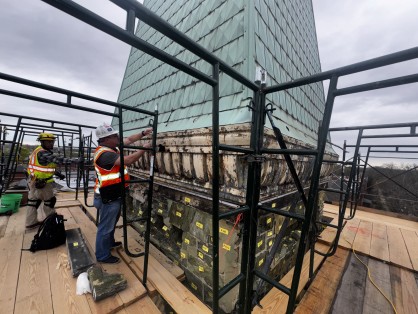
Greenstone United Methodist Church, named for its serpentine stone cladding and located in Chicago’s historic Pullman neighborhood, is getting its first significant exterior repairs since it was constructed in 1882. The 144-year-old church is a staple of the Pullman Neighborhood and National Historic Park and has received a $1.2 million grant from the Chicago Department of Planning and Development’s Adopt-a-Landmark program.
WJE has been involved in the project since 2017 when we performed a condition evaluation of the exterior facade and developed prioritized repair recommendations. In 2022, WJE was engaged in the project when the initial $1 million grant was awarded to restore the tower. While construction did not proceed at that time, the project was subsequently re-submitted and reviewed and fully approved in 2025. With grant funds now released, restoration work is slated to begin in 2026.
WJE’s Chicago office has been engaged to prepare repair documents, provide support related to the City of Chicago’s Adopt-A-Landmark Program, and oversee construction efforts, involving the complete removal of the tower’s weathered stone exposing the structure’s brick substrate. Since serpentine stone is not suitable for exterior use, especially as cladding material, cast stone units will be fabricated to match the original stone finish, size, and profile to retain the historic building aesthetics.
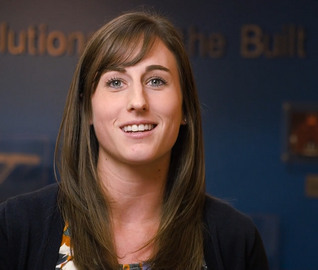
“An exciting challenge of the project is the full replacement of the existing serpentine cladding. As preservationists, we typically favor repair or replacement cladding material in kind; however, serpentine is not considered a durable or viable building stone for exterior use, particularly in climates with repeated freeze-thaw cycling,” said Nicole Declet, WJE project manager. “What makes this project especially interesting and complex is the irregularity the existing stonework. There is no consistent coursing, unit sizes vary throughout, and the finishes vary across the tower. Therefore, it requires a high level of documentation and coordination upfront to make sure the new work matches the historic layout and appearance as closely as possible.”
Read the full article in the Chicago Sun-Times.
RELATED INFORMATION
-
 Our professionals balance the need to provide practical, long-term solutions with the ability to... MORE >Services | Historic Preservation
 -
 Our professionals deliver practical repair and rehabilitation services that maximize the... MORE >Services | Repair and Rehabilitation
 -
 Nicole M. Declet, Senior AssociateWJE Chicago MORE >People | Nicole M. Declet, Senior Associate
 -
 Learn about our Chicago office MORE >Offices | Chicago