



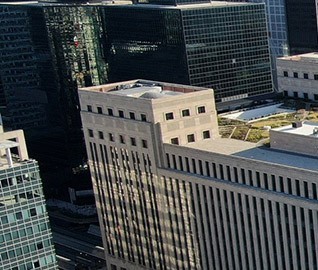





In March 2023, winter storms produced two significant wind events in San Francisco within a span of one week. Glass at several mid- and high-rise buildings fell to the street below, resulting in “shelter in place” directives and local media coverage. Additional storm-related glass breakage and other facade failures occurred but were not as widely publicized. Following WJE’s investigation of these buildings, the City of San Francisco issued revisions to their Facade Inspection and Maintenance Program. Primarily affecting buildings fifteen stories and taller, these changes were intended to safeguard against future failures and have already led to the identification and repair of broken glass on other high-rises in the city.
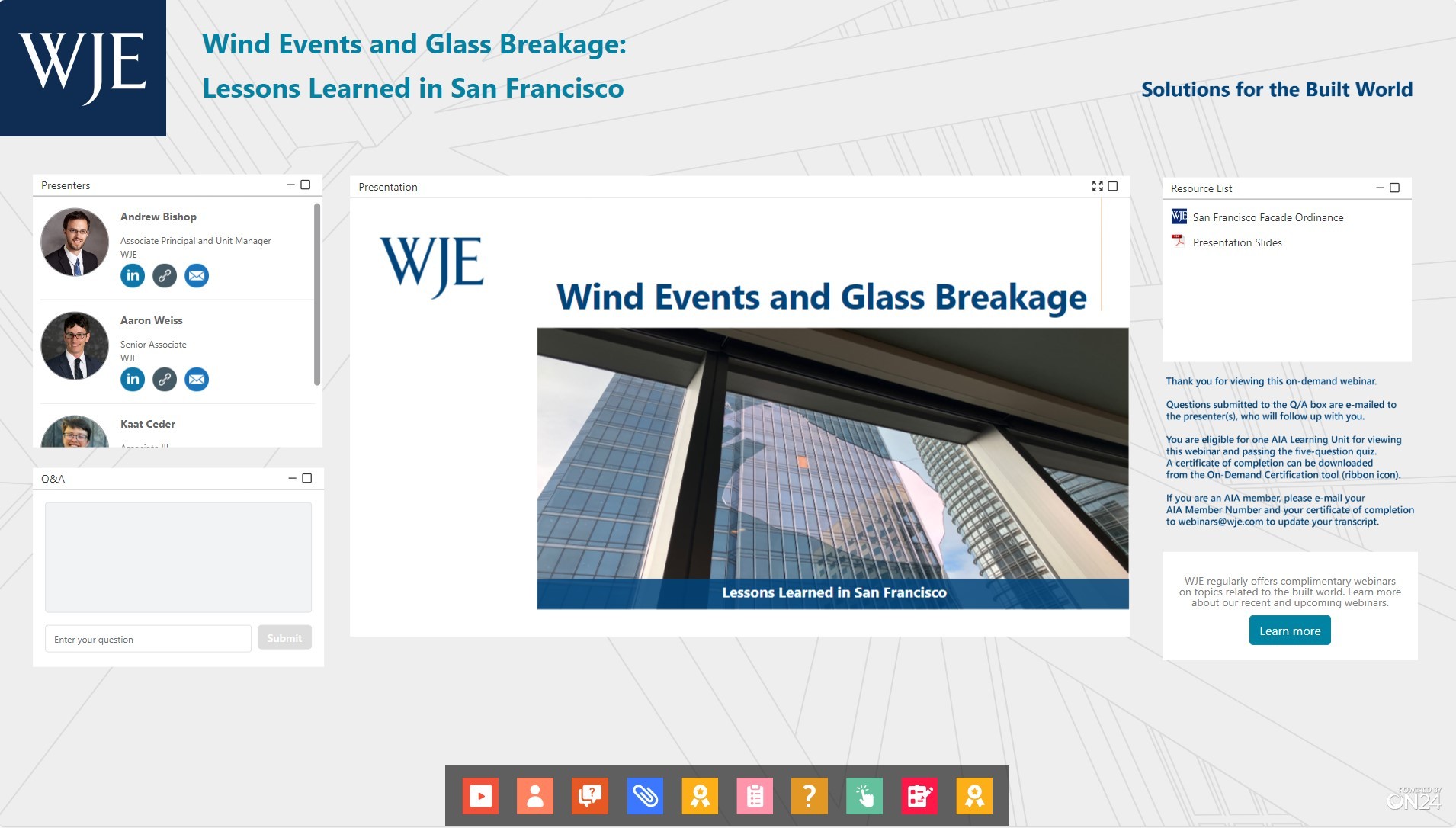
In this one-hour webinar, architects Andrew Bishop and Aaron Weiss, along with engineer Kaat Ceder, discuss the failures observed in San Francisco, explain recent updates to the city’s facade inspection and maintenance program, and offer practical recommendations for owners and facade designers—in San Francisco and beyond—based on their investigations.
more to learn
View this webinar in our interactive audience console to earn 1 AIA HSW learning unit, access related resources, submit questions to the presenters, and download a certificate of completion.
Kaat Ceder, Senior Associate
Aaron C. Weiss, Senior Associate
LIZ PIMPER
Hello and welcome to today's WJE webinar, Wind Events and Glass Breakage: Lessons Learned in San Francisco. My name is Liz Pimper and I'll be your moderator. During the next hour, architects Andrew Bishop and Aaron Weiss, along with engineer Kaat Ceder, will discuss the failures observed in San Francisco, explain recent updates to the city's Facade Inspection and Maintenance Program, and offer practical recommendations for owners and facade designers in San Francisco and beyond based on their investigations. This presentation is copyrighted by Wiss, Janney, Elstner Associates. And now I will turn it over to Kaat to get us started. Kaat.
KAAT CEDER
Thanks Liz and welcome everybody. Thanks for being here. We're here to talk about wind events, glass breakage, especially on taller buildings and specifically some lessons we learned from some big winter storms last year here in San Francisco. So to get us started, here's a few learning objectives. In general, we're going to talk about common types of glass breakage, especially in high rises and what makes an unsafe condition. We're going to talk about how property owners can kind of mitigate the risk of broken glass falling to the street, which is really something we'd like to avoid. We're going to talk about design considerations for architects, facade designers, and other specifiers that lower that probability of glass falling to the street and really help their clients kind of reduce their risk there.
And then we're going to talk a little bit about the San Francisco Facade Inspection and Maintenance program, which is very similar to other facade ordinances that we see in cities around the country. So a little bit of an outline. We're going to first talk about our case study here in San Francisco a little bit and identify different types of glass breakage we saw there. We're going to talk about how those could have been avoided and again, get into those lessons learned and then as I said before, get into the facade inspection program. A little bit of background here. So last year in San Francisco we had one of our wetter winters and we had several large storms. For those in the audience who were here, you may remember these.
There were two large storms in March of 2023 on the 14th and the 21st. You'll see a little video popping up in a little screen on your viewer. These are some of the winds that we saw during those storms. You see the kind of swirling patterns. We got some pretty high winds and that was causing damage throughout the city. You can see a little picture there of a bridge with damage and glass falling from high rises that really made the news all over the place. So coming up next is a video from social media. Some of you may have seen it and we're just going to watch that real quick.
KAAT CEDER
So as you can see in the little replay going here, this is a couch flying off of presumably someone's balcony in downtown San Francisco, getting lifted up from the balcony and flying down across the street and falling down on a sidewalk. So that just kind of goes to show really what kind of winds we're dealing with here and also somewhat the level of preparedness in the city for winds like this. So following these events, the city of San Francisco was really concerned about glass falling out of high-rises and other things. And we ended up looking into seven different buildings across the city, so mostly centered in downtown, right in the financial district, and then somewhat further south.
Across these seven buildings, there were 31 panes of broken glass that were observed during these winter storms. And our objective here was to figure out why. Why did these panes break? And was there something that could be done about it? We started first by looking into the meteorological data. We contacted a local meteorologist who we've worked with before and he got us some data about the max gust speeds in downtown San Francisco. And we got two numbers from him. The 14th we saw 75 mile per hour gusts, and on the 21st we saw 60 mile per hour gusts. So this doesn't sound like a lot for those of you who may be in hurricane regions, but for this area that's actually quite high.
And it's actually quite close to what we consider a design-level wind event in San Francisco when we're looking at window glass. So we typically design to 74 miles per hour. So we've exceeded that on the 14th and we're getting close to it on the 21st. So our logical kind of next question here was, "Okay, so is the strength of the glass the problem? Is that why we're getting those 31 panes of broken glass across those seven buildings?" So we did a bit of an analysis. We followed ASTM E1300, which is the standard practice for determining load resistance in glass, which is then adopted into the California building code and the IBC. This document prescribes a maximum 0.8% probability of breakage in a fifty-year wind event.
So just to get into that a little bit, glass strength is calculated probabilistically. So in this case it's an eight in 1000 chance of happening. This is generally done because there's so much variability in all of the things that go into glass strength that it's really difficult to come up with hard numbers that can provide zero breakage at a certain design level. That would be very difficult and often overly conservative. So instead we kind of determine what is an acceptable level of risk. And in this case, the profession has determined eight in 1000 and that would mean in a design level event you could have up to eight pieces of glass per 1000 break.
We then went into each building specifically, looked at the locations that broke and calculated what the probability of breakage for the type of glass that they had, the size of the window and the wind speed that they saw at that location. And then we calculated the probability of breakage and almost all of them were less than one in a million, which is effectively almost zero. Only one location exceeded that allowable 0.8%, which meant maybe in that spot it was a glass strength problem, but in all of the other places what we really thought was, "Okay, it's probably not the glass itself." Just to discuss that 0.8% a little bit more. So this is kind of the acceptable risk tolerance that the profession has decided we're going to design to.
If we were truly designing to that point 0.8%, in a city like San Francisco with two to 300 high-rise buildings, half of them having primarily large curtain wall glass facades, we're talking about thousands of breaks potentially in a design level event like we saw last year. And we saw much less than that. Why is this? Well, there's a few reasons. So one, we designed glass pretty conservatively, especially heat treated glass. Andrew will get into this a little bit more later, but lots of glass these days, especially in high-rise buildings is heat treated to some extent to make it stronger. And when we design that glass for certain wind loads, it's pretty conservative.
In addition, the wind in these events we're talking about was primarily coming from the south. It was really coming in one direction, meaning that not all sides of the building were loaded to kind of the highest that they may possibly expect. And then finally, not each piece of glass is individually designed when a building is built. They're generally designed in zones and that means that there's probably excess capacity in a lot of areas. So while this may have been a design level event for the building, most pieces of glass in there are probably designed for something slightly higher because we kind of design areas of that time.
So this is all to conclude this probably wasn't a glass strength problem, it was likely something else. So I'll pass it over to Andrew now to talk about the rest of the investigation.
ANDREW BISHOP
Thanks Kaat. I was really happy to get to work with our engineers on this project. I'm an architect myself, so I thought, "Well, surely I'll be able to add something to this project while the engineers tell us exactly how bad the strength problem was." There had been other experts giving TV interviews also saying it was a strength problem, so I was somewhat surprised when the ball came back and was in my court to look at broken glass and do kind of a more traditional glass breakage investigation. Before we dive into the specifics of glass breakage, we're going to talk a little bit about just terminology to make sure we're all on the same page here. Different types of glass.
Annealed glass is your most basic kind of float glass, comes off the float line and cools at a normal rate. This is kind of your standards most affordable treatment of glass. Heat strengthened glass, however, is twice as strong as annealed glass and both of these kinds of glass break in a similar manner, what's shown on the screen right now. Whereas tempered glass is twice as strong as heat strengthened glass or four times as strong as annealed glass and has a very different breakage pattern. This looks much more like a spider web of breakage and this is what your car windshields will also have. Another terminology, just to make sure everyone knows what part of the building we're talking about here.
Spandrel glass. There's vision glass that you look through and then there's spandrel glass typically at column lines and floor lines. The main difference from a risk standpoint is that spandrel glass cannot be seen from the interior. If it breaks, a lot of people could be working in that building and not know that there's broken glass. There's typically a couple of things you can use to make a glass opaque. You can put a ceramic frit on the inside surface of the glass. You can put a silicone flood coating on that glass and you can also cover it with a piece of aluminum or insulation, which is what's called a shadow box. So those are a couple of the terms we'll be talking about.
Just want to make sure everyone knows them before we get to those points. The different types of glass breakage that we're going to talk about. Kaat already covered the first point there, overloading, the winds that are too high or under strength, glass that's either not the right temper or isn't thick enough. And in our investigation we really didn't find strong signs of that happening. The other items that I'm going to go through here one at a time, thermal stress is breakage of glass caused by temperature differences. Contamination is foreign materials that get into the glass at the time of their fabrication. Hardware failure is operable windows and the hardware that either keep those windows open or help them to pivot. Impact is just things hitting glass.
That's kind of your most common. Edge defects are small imperfections at the cut edges of glass. We didn't find any examples of that in this investigation, but it is a common type of glass failure. So included here just in the outline. We won't talk about that one in depth. The other item is inner story drift. When buildings move under high winds or here in San Francisco they move a lot more under seismic loading. Those buildings can move far enough that they can cause the glass in the window openings to break. We did not evaluate that as a failure method because there was not an earthquake to cause that kind of movement, which in San Francisco at least buildings are primarily controlled by seismic loads and there was no earthquake, so we kind of ruled that one out from consideration.
Also, performing a complicated structural analysis on all seven of these buildings wouldn't have been a very good use of taxpayer dollars. So again, just included here as the outline, but we won't be diving into that. All right, so let's jump into the first one that we haven't talked about yet, thermal stress. So thermal stress is a very common form of glass breakage. It's most widely known in mid-century high-rise buildings and that is because mid-century high-rises at their spandrel glass at the floor line, they would typically use a single pane of glass. Typically, heat strengthened. Uncommonly that's tempered glass and they would have a ceramic frit on the inside surface. Ceramic frits are also another kind of currently known cause of strength reduction in the glass.
Another thing that's common in mid-century high-rises is that they have insulation directly in contact with the inside face of that spandrel glass. That serves to make the glass a lot hotter, particularly in the middle of the glass where it's not in contact with aluminum, which helps to cool off that glass edge. You also have things in high-rise mid-century buildings like the one on the screen where you have a large concrete element which also has a lot of thermal mass to it and that can keep the edge of glass cooler than it normally would be. And it also creates differential shading and what we see here on the image is a break origin coming from the shaded edge of the glass right near the middle of the glass and both of those are telltale signs of thermal stress breakage.
If you do have samples of the broken glass available, which we did not on this project, you could actually look at the breakage remains to see the orientation of the breakage plane and if those are perpendicular to the edge and perpendicular to the face of the glass, that's another telltale sign that it was thermal stress induced. That's going to be a theme of today's webinar is that the contractors that showed up to mitigate a lot of these buildings in San Francisco did a great job of responding quickly, mitigating the hazard to the public. However, they were equally efficient at throwing away all of the broken pieces of glass, which makes that last part of our analysis not possible in a lot of these instances that we looked at.
Another common thing we talked about in mid-century buildings, how they put insulation at the slab edges. One of the properties was having a tenant improvement project and the contractor doing the interior work took a similar approach to protect the glass from their work. They added insulation over all of the vision glass using a thick foam insulation product and that insulation works the same way as slab edges. It makes the center of the glass very hot while the edges remain cold and that temperature differential is enough to break even large thick panes of glass like this. They did document this breakage before the storm even came in, so we did have documentation of that. This pane was actually broken due to something prior to the storm's arrival.
To mitigate the risk, they knew the storm was coming. They applied a security film. This is a common approach that glazers try. Security films or tape. You can see they have both. However, security films and tape do not really provide structural strength. And the video player should start here any moment to show what happened to one of the panes of glass that was secured with the security film. You can actually see a bit of the film still adhered onto a piece of the broken glass that was blown out of the opening by the storm. So there are some rules of thumb on security films that could improve their performance. Generally you want to put them on the outside of the broken piece of glass.
You want to run those in continuous sheets rather than in small piecemeal sheets. You want to run those continuously from mullion to mullion and you want to attach them to the mullion with fasteners or strapping, some mechanical method, not just relying on adhesion of that film or of that tape. And I definitely want to emphasize if this property wasn't enough of an example of shortcomings, of failure of films, it should really only be considered an emergency option if there's no way to get on the outside of the building to remove broken glass or put up plywood to mitigate the risk of broken glass falling to the street. That these films and tape in general should be really considered a last option.
So other items that we're not going to dwell on much here with thermal stress, there are a lot of other items that can cause increased risks of thermal stress breakage. You can reduce the strength of the glass by having damaged edges or ceramic frits or having the tempering not be as good as it should be. You can also generate excess heat from shadow boxes or dark glass or absorptive low-e coatings, the adhered films, tinted interlayers. These can also cause excess heat generation and then shadows cause differential heat on the glass, right? So shadows will create cold spots on the glass. Heat dissipation as well. You can reduce glass's ability to dissipate heat to the interior by putting heavy blinds or unvented air spaces or insulation directly on the inside face.
And then again, creating cold spots at the edges are the other thing that you really want to avoid to mitigate the risk of thermal stress breakage. All of these variables are knowable. I just want to point that out that there are analytical methods. ASTM and AAMA have not really formalized a lot of these methods, but they are available and it's something we regularly do on new construction projects at least, and when there's suspicions of thermal stress failure is to perform an analysis. There's a lot of analytical tools that make this very common problem avoidable. The next type of glass failure mode we're going to talk about is glass contamination. Again, this is foreign material getting into the glass on the float line or during the batching process before it goes into the float line.
And this has a telltale sign at the breakage origin. You see two little circles that are sometimes called cat's eyes, but I think look more like a figure eight. The important distinction is that the inner and outer surfaces at the break are very, very smooth. You have tightly joined fragments of broken glass. This only happens in tempered glass, so not in annealed and heat strengthened. And often if you get close enough you can see a small foreign object often called a stone or an inclusion within the breakage plane. So you can see that outlined in the dashed line. Typically, the contaminant is nickel sulfide. There are lots of other contaminants that are less common that fall into glass.
A lot of glass warranties will exclude nickel sulfide, but if you take the sample to the laboratory, you can tell if it's nickel sulfide or if it's something else that might be covered under glass breakage warranties. And here's a close up of that inclusion. One of the methods we were able to use on the buildings in San Francisco that had suspicions of this type of failure was to go to Google Earth and look in street view on the property where there was suspicions of nickel sulfide. We were able to use street view to actually confirm that the glass was broken at least in February, if not January of 2023 before that storm, which came in March of 2023. And you can see that through the clarity of reflections there.
You can see the 2021 photo in particular, you can see very clear reflections of the building across the street. Whereas by 2023, that reflection while remaining in the adjacent panes of glass is no longer visible in the pane of glass in question because that pane of glass was likely broken but simply had not fallen out of the opening. So that's what the storm in March contributed, was wind loading sufficient to pull broken glass again off of a building where it had already been in place. The next type of failure method we'll talk about is hardware failure. This only happened at one window, a large operable window, which is very common in new construction to have very large windows that are operable to give residents some control over thermal comfort.
These, I'm sorry to say, do not have an industry standard pointed at how the windows should perform when the window's in the open position. It is a requirement for residential windows, things that are covered under AMMA 101, but storefronts and curtain walls and high-rise glazing in general doesn't fall under the purview of AAMA 101. So the test there isn't really appropriate because it's more geared towards someone is trying to forcibly close a window that's left open and the load applied to that is just much less than what large windows like this experience during a windstorm. So windows in their open position are something that I think the industry is presently working on, but we'll take a closer look at the suspected piece of hardware that failed here.
This is called a hold open device, also called the stay arm sometimes. This item was known to have spontaneously closed under other loading events in prior years. This goes back several years previous to the storm of 2023. And similar in this storm, if a window was left open and that hold open device doesn't function, the window can close very suddenly or be pulled open again very suddenly. Either of those are kind of loads that this piece of hardware is not designed to see. And we'll again load another video here so that you can see what was occurring during the storm. Folks across the street were able to see that the window... After the hold open device was no longer functioning, you can see the window was able to open greater than the four-inch code requirement.
But then also was able to come back against the building, which is what we believe is what broke the inner pane of glass on this IGU. So the next thing we're going to talk about is impact damage, right? The operable window hitting against the opening broke the glass above and actually a few stories below on the same building, we found signs of more impact damage, but on the outer pane of glass. So we can zoom in on what that looks like. In impact damage, there are some telltale signs that we're looking for. In annealed glass, you want to find the origin. What is the first part of this glass that broke? And inside the breakage plane there are these parabolic kind of ripples is what they look like called Wallner lines.
So I'll highlight those again in yellow. These Wallner lines always point away from the origin point. So throughout all of the other parts of the broken glass, you'd be able to see a Wallner line and follow it back to this point where you can get much closer to the view of that location and you can see some localized kind of powdery areas that's crushing of the glass. You also see these kinds of shell shapes. Conchoidal fractures are what they're called. Both of these are signs of impact damage. You can also find this in a lot of your ceramic glassware and dishes if you happen to put your dishes away a little too quickly sometimes and chip an edge. You can also look really closely and you can see these similar conchoidal fractures.
So that's something we're able to look for to find signs that this second pane of glass on the same building was actually broken by glass debris falling from above that just in the turbulent wind during the storm was forced back against the building and caused further impact and damage. Across the street, the neighboring building also had a lot of broken glass with similar signs of impact damage. There were also a lot of panes of glass that didn't break. And on several of those panes we were able to see scratches on the glass, scratches on the aluminum. Typically, when you have flying debris you'll see other signs of damage that point to that as a cause. Proximity certainly is a clue.
If one thing is right next to another that can be strong evidence of causation. Also looking for adjacent debris, we were able to find on the roof of several buildings that we suspect had impact damage, we were able to find debris from neighboring buildings. So with that glass, you can look at the thickness of the glass, the color of the glass, and we're able to measure something called RCSS, which can tell us how tempered is the glass. Is this highly, highly tempered glass or is this ever so slightly heat strengthened glass? We're able to measure that using laboratory tools as well to show that there was a relationship between glass on someone's roof and relationship to the glass on the neighboring property.
One thing to look out for with impact damage with glass that's still in place and hasn't fallen from an opening, that impact damage can also have a very similar figure eight pattern. So just seeing the figure eight pattern that I mentioned earlier isn't your only piece of evidence you need. You need to get very, very close and again, look for those signs of powdery crushing or conchoidal fractures at that origin. That's how you can tell at least through field observation without lab testing the difference between impact damage and glass contamination. So to summarize these, those were all the breakage methods that we were suspecting for these 31 panes of broken glass. To summarize them here, you can see one commonality is of the panes of glass that we suspect were broken before the storm.
They were all spandrel glass or were covered at the interior, preventing confirmation, preventing folks on the interior from knowing that the glass broke. We were working for the city on this. They wanted to know about their [inaudible 00:30:47] facade ordinance and inspection program and they wanted advice on what could be done. So if we were focusing on things an inspector could find before a storm, a hundred percent of those things were spandrel glass. So if the city was going to consider any changes to their requirements, we felt those requirements should be focused on spandrel glass because that at least in the results of this particular windstorm, that spandrel glass was the only thing that could have been looked at prior to the storm.
Another I'd argue more important issue to focus on is kind of the cascade failure effect, right? A pane of broken glass that's in place before the storm comes in that doesn't get corrected quickly is actually what caused much more of the panes of broken glass here. You can see 26 out of the 31 total here we're calling avoidable. Had folks been able to correct those problems quickly. So to that point, one of our recommendations here is to address known problems as fast as you can, which is easier said than done. The challenges to acting quickly, the most common one we had even in performing our investigation months after the storm was getting access to that pane of glass.
Getting to the outside of a building is difficult. So maintaining a facade access system that is operational at all times and has spare parts that you know break commonly, having them readily available so that you can get to the outside of your building if there is an emergency. To do that quickly is extremely important to avoid having the street in front of your building shut down. Removing broken glass. That one I think is an easy one. Glazing contractors will tell you that they're comfortable using tape, they're comfortable using security films. Glazers are also the people that are riding swing stage regularly. They have a different level of comfort with risk than I think some building owners have.
And having a frank conversation with your consultants and with glazing contractors about what is your level of risk tolerance and making sure everyone's on the same page there, is an important part of the process that I think engineers and architects can certainly help facilitate as well. Another point that I would love for owners to take away from this is after you make that emergency call to get a glazer to help you. Try to ask them after they're done securing the site to not throw everything away. There was very little remaining for investigation, but we were able to come to some conclusions, but it would've been much more definitive if we had physical evidence to look at.
So it's to your credit to try to preserve some of those broken panes of glass so that you can have more clarity on what caused the breakage if there is a question. One thing that my colleague Aaron here will get into next is talking about the changes to facade ordinance. One of those things is a log of breakage and knowing the cause of that breakage will be a lot easier if you maintain that debris. The other thing I'd like to stress is some of these panes of broken glass that fell from openings were rather close to the street. I think the lowest one was on the fifth floor. So regularly going outside and looking up at your building is something that's very easily done. Doesn't require hiring a third party inspector to do.
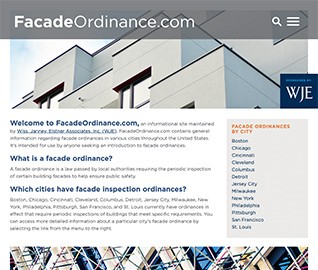
A lot of this was knowable. And for some of the properties actually, there was a history of glass breakage where the fire department came and all they did was look up at the building and found several panes of existing broken glass that hadn't been removed. Another thing, especially for folks not in San Francisco, we're not going to go in depth on other facade ordinance around the country, but we do have a website here, facadeordinance.com. That summarizes a lot of those requirements for when you need to hire a third party facade inspector to look at your building. We'll get onto the next slide here that is geared towards designers, engineers, fabricators, delegated designers.
Our takeaways from this investigation are that we need to underline to owners that spandrel glass is a higher risk material than vision glass or aluminum panels. When they're broken, they cannot be seen from the interior and that simple fact raises their risk profile. So try to be selective when using spandrel glass. Make sure you've talked to the owner developer about that risk, knowing that they're going to have a building that might require more immediate repairs if glass does break. Other things to consider, using heat-strengthened glass, which will be stronger, less prone to breakage. Using laminated glass, which once broken is less likely to fall out of the opening.
Making sure you have decent sized air gaps between the glass and the insulation that's ventilated to avoid thermal stress. If you absolutely have to have spandrel glass, consider using opacifiers rather than frits. Opacifiers do make the glass hotter, but they don't reduce the strength the way frits do. Also analyze this risk, right? If you're going to do something that might be a higher risk material and the owner is on the fence about it, this is analyzable, so consider doing that. Another thing to avoid is tempered glass on the outer pane. As we saw in several examples, once tempered glass is broken, it's pretty unstable and it's very likely to fall out of an opening.
If tempered glass has to be used on the outer pane of glass require heat soaking. And heat soaking is not really observable unless you go to the glass factory and watch them do it. So some level of quality assurance, especially if procuring glass from overseas can reduce risk. Also, in the last point, which I've seen several facade consultants and architects of record also doing now is adding new test requirements to their performance mock-ups to try to test operable windows while they're in the open position. I've seen several permutations of this and in my book, they're all good ideas and I'd love to see how some of those tests go.
So I hope as a profession we keep talking to each other and sharing lessons learned on how some of these early ideas go when they finally make it to the testing phase. With that, I'm going to turn it over to my colleague Aaron, who's going to talk about the Facade Inspection and Maintenance Program.
AARON WEISS
Thank you, Andrew. I'm going to begin with a brief overview of San Francisco's Facade Inspection and Maintenance Program as it was initially implemented and active in 2023, for those of you who may not already be familiar with it. Then I'm going to discuss the recent changes that the city has made to the program in response to the glass breakage that we investigated last year. San Francisco's Facade Inspection and Maintenance Program, which I'll abbreviate as the FIMP, was enacted in 2016 and applies to buildings five stories and taller. The initial inspections began in 2021 with the oldest buildings in the city constructed prior to 1910, and the inspections progressed through the city's building stock according to building's age, going through the oldest buildings first.
By 2027, the program will have required inspections for buildings constructed through 1997, and buildings newer than that are inspected 30 years after their original date of construction. And all buildings are re-inspected every 10 years under the program. The basic inspection procedures are based on a national ASTM standard and are similar to facade ordinances in other cities around the country. The basic inspections include both a visual and tactile component. General inspections require a hundred percent visual observation of each facade, which is typically performed from sidewalks using binoculars and telephoto cameras. Drums are permitted as a tool for use during the visual inspection, but in our experience they're not widely used.
Generally just binoculars and cameras are used. Based on the results of the general inspection representative locations are selected for a detailed close-up inspection, which is performed within six feet. Close enough to touch and includes tactile evaluation of facade components. The detailed inspection is typically performed from swing stages, boom lifts, sometimes from fire escapes, and occasionally using rope access, which is similar to rappelling. When the glass breakage occurred in early 2023, the FIMP was conducting inspections on buildings constructed up until 1925, which typically have masonry and concrete facades, punched windows and don't generally have spandrel glass or modern glazing.
The most common types of deterioration and damage on these older facades such as cracks, spalls, displacements, and corrosion are typically the result of age, weather exposure and deferred maintenance. These conditions develop and progress over time in a relatively predictable manner. After investigating the glass breakage in 2023, WJ was asked to review the FIMP and to provide recommendations to improve it to reduce future risks from glass breakage in San Francisco. Unlike most conditions encountered during facade inspections, glass breakage can occur at any time. Spandrel glass is at a higher risk of breakage and at a higher risk of remaining undetected.
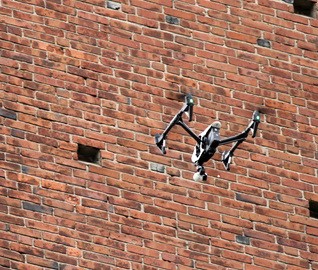
Visual inspection is effective at identifying broken glass if a good enough view of each pane can be achieved and the use of drones is a very valuable tool, especially on taller buildings. So then we reviewed the FIMP as it existed in 2023, which as I described, had focused on the oldest buildings in the city first. In 2023, the FIMP had not progressed to the newer buildings that contain large and more complex glazing and spandrel glass. Many of the buildings that experienced glass breakage in 2023 were not scheduled to be inspected for several years, and some were not scheduled to be inspected for several decades.
The FIMP's 10-year reporting cycle also seemed too long to identify broken glass or too infrequent because the broken glass can occur at any time and without warning. The FIMP already included a requirement to inspect damage or failure that may occur, which requires a limited facade inspection and report to the city within 60 days. The FIMP also include a requirement to report unsafe conditions to the city, which require urgent action by the owner to mitigate the hazard. Both of these requirements technically apply to broken glass, but were not widely known at the time or implemented. The city made preliminary revisions to the FIMP in direct response to the glass breakage and required the newest and tallest buildings in the city to perform what became supplemental inspections immediately.
Followed by more comprehensive revisions to the FIMP based on the recommendations that WJE provided based on our findings from the investigation. The main change to the FIMP was the addition of this supplemental inspection, which is a visual inspection intended to identify broken glazing. Supplemental inspections apply to buildings 15 stories and taller, which tend to have glazing at upper floors that is difficult to view from street level. Supplemental inspections also emphasize spandrel glass, which is typically not visible from the building interior and is at a higher risk of breakage and remaining undetected once broken. Newer buildings require supplemental inspections five years after construction and every five years until the first comprehensive inspection is required at year 30.
Older buildings require supplemental inspections at the five-year midpoint between comprehensive inspections, so the buildings alternate between comprehensive and supplemental inspections every five years. Buildings that do not contain any spandrel glass can qualify for an exemption from the visual inspection requirement if they maintain a glass repair log and it shows that there has not been any glass [inaudible 00:44:20]. To reinforce that the recommendation to add supplemental inspections to the FIMP was a good decision. During our first supplemental inspection of a tall building in downtown San Francisco that wasn't scheduled for its first inspection for 20 more years, we identified a badly cracked pane of spandrel glass at the 43rd floor.
We identified this by reviewing drone photography, and I show the first three photos here on the left, just demonstrate how different the view of the break is depending on the lighting and perspective of the camera. In the left, you can sort of barely see the broken glass at all. The second photo it shows it and should be detected by an inspector while reviewing the photo. And then the third one really shows the magnitude of it. And once I knew where to look, I was able to look through my telephoto camera photos from street level and you can actually see it. Although I don't think I would've identified this as a problem necessarily with such a low-quality image. But condition was reported to the owner and city officials as a very unsafe condition, and the owner immediately restricted access to the space below the break,
WJ observed the broken glass up close using the facade maintenance equipment and determined that this damage was likely caused by impact by a small object. The broken outer pane was stabilized and removed by a glazing contractor and a replacement unit was eventually fabricated and installed. We hope that further supplemental inspections will reduce the risk of future glass breakage hazards in San Francisco so that we can avoid making headlines again. To summarize the lessons learned for inspection of facade glazing. Inspectors should assess spandrel glass, which has a higher risk of breakage and a higher likelihood of remaining undetected. Broken glass identified at any time should be investigated and logs should be kept to document the repair history and identify any patterns.
Spandrel glass should be inspected every five years to respond to the spontaneous nature of glass breakage. Glazing inspections do not necessarily require up-close access and can be performed from the ground using drones and cameras depending on the building height and visibility from the street. Thank you for attending this presentation. I hope you learned something interesting or useful about glass breakage in San Francisco. For more information about the San Francisco FIMP and similar facade ordinances in other cities, please visit www.facadeordinance.com. We'll now open the presentation up to questions and I will turn it over to Liz.
LIZ PIMPER
All right, thanks. Aaron. What makes nickel sulfide the typical contaminant during manufacturing?
ANDREW BISHOP
I'll take that one. It's not that it's more common than other materials. I think it's just the most common that causes breakage. It's extremely small. I'd like to highlight that. This is harder than a needle in a haystack, which is why you'll typically see a lot of glass manufacturers excluding it from their warranties just because of the monumental task required to find something that tiny. There are other contaminants that are common. They're simply less prone to cause breakage.
LIZ PIMPER
Our next question, glass breakage or windows popping out happened in Chicago 25 to 40 years ago, were there no lessons learned?
ANDREW BISHOP
I'd say there were some lessons learned. San Francisco did not even have a facade ordinance prior to that kind of trend in the industry. When that occurred, a lot of other cities started talking about facade ordinances, and it took San Francisco a little bit a longer to get on that bandwagon because we don't have freeze-thaw damage here the way a lot of other cities that had more pressing and urgent needs. In San Francisco, it really came out of a longer term durability questions rather than more immediate freeze-thaw damage that I think is common in the Northeast and in Chicago, much more so than here in San Francisco at least.
But I hope other cities can similarly learn from San Francisco here, that we're talking more about the risk of glass in general, which I don't think facade ordinance nationwide have really dealt with, and I think that's really only been a question here in San Francisco. So I'm glad we do have a nationwide group here listening in today so that we can share some lessons learned from San Francisco that I think other cities could think about.
LIZ PIMPER
Our next question is a multi-part. So it says, even if not mechanically attached to the mullions, does an application of a security film make the glass more resilient by holding it all together and creating a larger mass for the wind to act upon? And being held in one piece, wouldn't it require a larger portion of the mechanical attachment around the perimeter to fail before the glass can blow out?
ANDREW BISHOP
Kaat, let me know if I'm missing anything on this, but I do believe a film is better than no film because it does... Especially if it is mechanically fastened, you're getting a little bit of additional span resistance from mullion to mullion. It does mean if the piece does leave the opening though, that you have a much larger piece typically that's falling as one piece. That's kind of the risk of laminated glass as well. You have a better chance of it not falling off the building, but if it does, tempered laminated glass is going to do a lot more damage than just unlaminated tempered glass. Kaat, do you have anything else on that one?
KAAT CEDER
I think you hit the big points. I think the only thing I would add, basically the benefit of a film is that it attaches the broken pieces to the unbroken pieces, but specifically to the unbroken pieces that are still attached back to the building. That's why attaching a film to the mullions is great because those mullions are attached to the building and that provides some load resistance. I think the big thing to take away from the presentation is if you know there's a storm coming, then really the film is maybe not going to cut it. And that's really the big one. It's better than nothing, but it's not going to keep your glass in place in high winds necessarily.
LIZ PIMPER
This question is, were failures ever due to local building shape perhaps causing suction or venturi effect stresses on glass?
KAAT CEDER
Sure. I'll hop in here first. I mean, as Andrew kind of discussed and I discussed, we don't think there were if many or any direct kind of strength related breaks, but there was glass be that evacuated the opening because it was on the leeward side of the building. In other words, the side of the building that experienced a negative pressure or a suction, which kind of pulled out the glass from the opening, the glass that was broken already, potentially in many cases, but then that suction negative pressure pulled it out of the opening. So in some ways, yes, but that's also unavoidable. There's always going to be a leeward side of the building in a storm, and we just need to prepare for that.
LIZ PIMPER
This one's clarifying question. The person is asking, "So the cracking could be from a previous impact or storm, but the latest storm dislodged the spandrel."
ANDREW BISHOP
Exactly, yes.
LIZ PIMPER
All right. Should window cleaning services be tasked with reporting window breaks?
AARON WEISS
Absolutely. I think everyone who works on buildings, including occupants and managers, should all be tasked with reporting any broken glass that they see.
ANDREW BISHOP
I'd second that to neighbors across the street, right? Especially in a high rise environment. You looking at your neighbor might have a better vantage than that neighbor does. So I think this takes a village for us to reduce risk on these fronts. So owners should be neighborly and making sure others know that there's a risk.
LIZ PIMPER
This person said, "I've heard that exterior panes on fully tempered glass is good for heat stress resistance. Please advise."
ANDREW BISHOP
You're spot on. And this is where it becomes a balancing act. Fully tempered glass is the strongest glass, which makes it less likely to have thermal stress breakage. By having tempered glass, you introduce a new risk of A, when the glass breaks, it immediately can fall out of the opening. And B, You have the heightened risk of spontaneous breakage due to nickel sulfide. So my thinking on that is that there's a balance, and my preference if money were not an issue would be to have a tempered glass that's laminated and well attached to the building, but that is certainly the most expensive glass option out there.
So that's a really easy thing for me to say when I'm not the one writing a check for the facade package on the building. So in reality, it becomes a balance of cost and risk tolerance, but heat strengthened is a good middle ground, especially if you're able to mitigate the risk of thermal stress through those other factors, including a detailed analysis to tell you where you're at on that risk spectrum.
LIZ PIMPER
Our next question, what glass type is recommended for both wind and impact resistance, such as during a hurricane?
ANDREW BISHOP
No, I appreciate the hurricane question because it's a bit of a different mentality. Similar to blast engineering, what you're trying to do is safeguard the occupants on the inside of the building. So for that, laminated interior panes of glass are best, and there's even security films that get used even on the inside surface of the pane of glass, so that when that glass does break during a storm, that you're not throwing shards of broken glass at the interior occupants. The thinking could be the same in the San Francisco example. During the storm, there weren't people out on the sidewalks.
So broken panes of exterior panes of glass is certainly not a problem during a storm because there shouldn't be people on the outside during a storm. But as we saw, there certainly are some folks there and they certainly deserve safeguarding, but also after the storm passes, I think that is something that the facade ordinance and risk mitigation in general just hasn't focused on as much. I think is what the San Francisco example shows me at least, is that thinking of safety post storm is something that we need to pay a little more attention to.
LIZ PIMPER
Are inspections required after a new building is completed to assure there was no damage during construction?
AARON WEISS
No. No. The FIMP requires the first supplemental inspection five years after construction. The assumption is that at the end of construction, the contractor presumably should be inspecting the building for that type of damage, and it should be delivered to the owner in good condition.
ANDREW BISHOP
Good to have your design team involved on the punch list though, to look for those types of things.
LIZ PIMPER
All right. We've got time for one more question. This person said, "The slide showing the summary of likely failure mechanisms shows that all 24 windows broken by debris impact were avoidable. How so? Was it avoidable by the affected building owner or just avoidable in the sense that the debris in the neighborhood should have been better secured?"
ANDREW BISHOP
The latter. I'm thinking more in the, it takes a village mentality. That if we all lived in a wonderful world where everybody did exactly what they needed to do the minute it could possibly be done. That's what we kind of classified as avoidable. So unfortunately, it's not within one individual property manager's control, but addressing known issues, especially known issues that have been known for several years are what we consider as items that things that could have been done to avoid breakage.
LIZ PIMPER
Well, thank you Andrew and Erin and Kaat. That was a wonderful presentation. Thank you all for joining us. We hope it's been educational. So again, thank you so much for your time and we hope you have a great rest of the day.
RELATED INFORMATION
-
 Andrew J. Bishop, Associate Principal and Unit ManagerWJE San Francisco MORE >People | Andrew J. Bishop, Associate Principal and Unit Manager
 -
 Kaat Ceder, Senior AssociateWJE San Francisco MORE >People | Kaat Ceder, Senior Associate
 -
 Aaron C. Weiss, Senior AssociateWJE San Francisco MORE >People | Aaron C. Weiss, Senior Associate
 -
 Thousands of clients have relied on us to accurately determine the cause and extent of damage... MORE >Services | Failure and Damage Investigation