




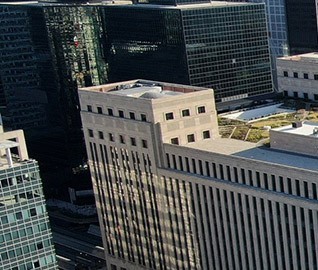
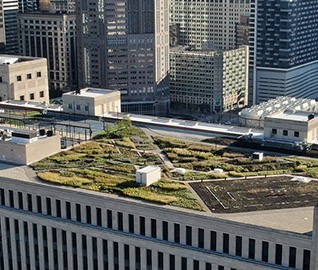
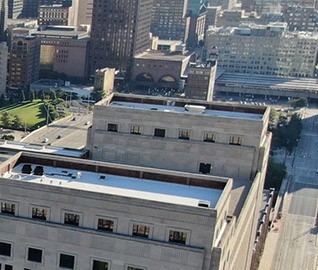





Adaptive reuse of existing buildings is one of our best options to increase sustainability and resiliency in the built environment. And, in recent years, economic and social shifts have made these conversions more financially attractive. Hybrid work arrangements have left office buildings underoccupied or completely vacant. At the same time, demand has increased for urban living spaces with easy access to public amenities. Converting commercial buildings to residential space is a viable solution for both problems.
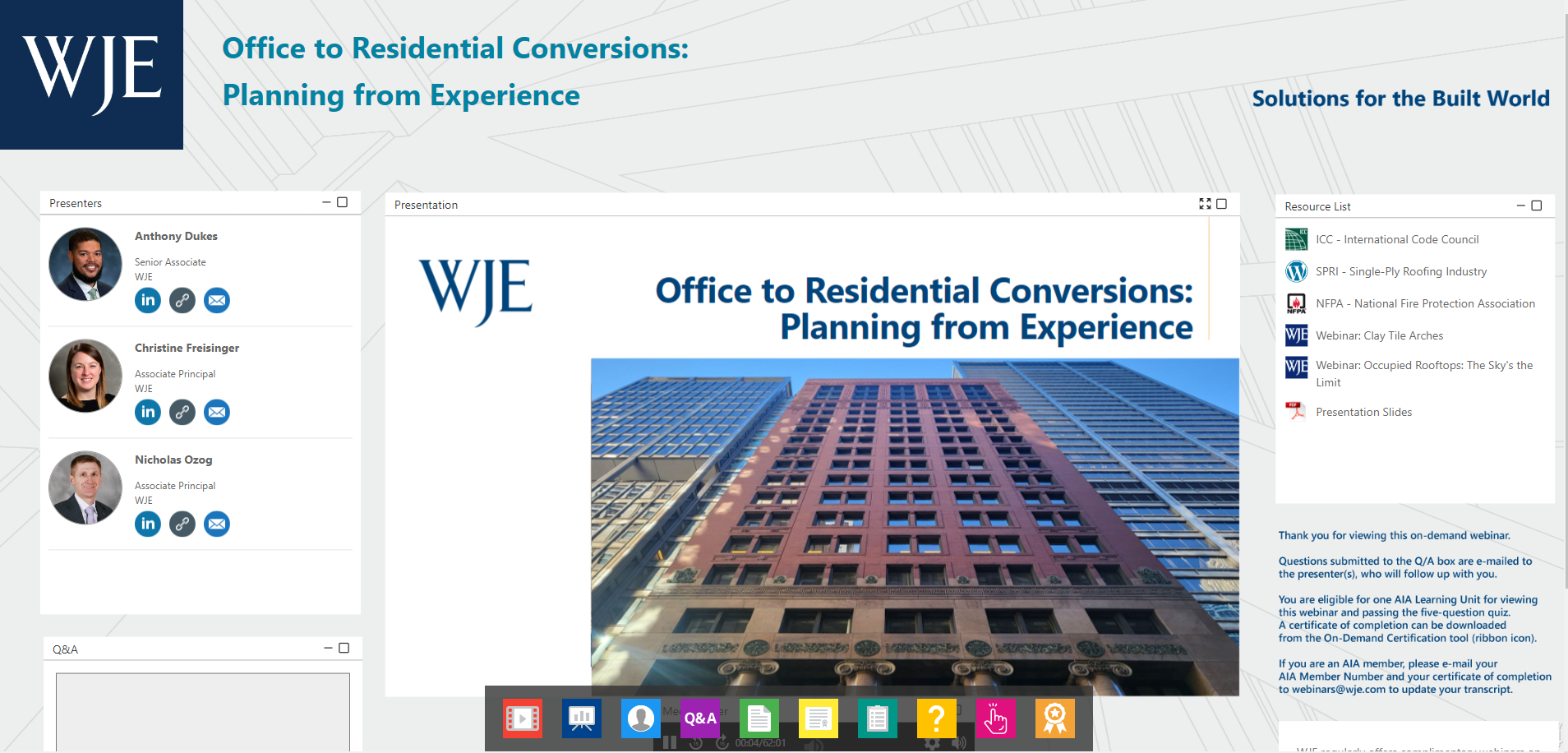
In this webinar, WJE civil engineer Anthony Dukes, structural engineer Christine Freisinger, and fire protection engineer Nicholas Ozog discuss common elements of office-to-residential conversions, including often-overlooked structural impacts, fire protection and life safety requirements, and building enclosure improvements that are important to any adaptive reuse project that results in a change of occupancy. This webinar will help property owners, developers, architects, contractors, and building officials navigate the complexities of these conversions.
By the end of the webinar, you will be able to:
- Identify design changes that may result in structural building modifications
- Describe how fire protection safety requirements change from office use to residential use
- Recognize building enclosure improvements to consider during adaptive reuse
- Explain the need for an integrated, multidisciplinary planning approach to the basic adaptive reuse principles that apply to office to residential conversions
more to learn
View this webinar in our interactive audience console to earn 1 AIA HSW learning unit, access related resources, submit questions to the presenters, and download a certificate of completion.
Christine M. Freisinger, Principal
Nicholas Ozog, Associate Principal
LIZ PIMPER
Hello, everyone, and welcome to today's WJE Webinar Office to Residential Conversions Planning from Experience. My name is Liz Pimper, and I'll be your moderator. During the next hour, WJE civil engineer Anthony Dukes, structural engineer Christine Freisinger, and fire protection engineer Nicholas Ozog will discuss common elements of office-to-residential conversions, including often overlooked structural impacts, fire protection and life safety requirements, and building enclosure improvements that are important to any adaptive reuse project that results in a change of occupancy. This presentation is copyrighted by Wiss, Janney, Elstner Associates, and now I will turn it over to Chris to get us started. Chris.
CHRIS FREISINGER
Thanks, Liz. Thanks everybody for joining us today. We're going to be covering design changes on structural modifications, protection safety requirements for change of use, looking at building closures, and also taking a look at the integrated planning process.
So I'm really glad everybody could join us today so we can share lessons from the built world as they relate to office to residential conversions. As Liz mentioned, I'm Chris Freisinger, a structural engineer in our Chicago office, and will be starting us off. Then Nick, who is a fire protection engineer in our Chicago office, and Anthony, who's a building enclosure consultant in our DC office, will be joining. Office-to-resi conversions have been a hot topic lately with the combo platter of older building stock, hybrid or remote careers, the need for affordable housing, and tax incentives from the government. These conversions can be considered a subset of adaptive reuse projects which breathe life back into buildings with new uses.
Loft conversions are a great example of warehouses or factories that have already been turned residential, and while the concept of adaptive reuse is not new, there are a few considerations that pop up more in residential conversions than other types of reuse projects. These conversions can be successful with the right choice of building and a focused team effort. Nick, Anthony, and I plan to cover code reviews, modifications to roofs, facades, and structural systems, and aspects of fire and life safety. Throughout the presentation, we will tie in connections between structural building enclosures and fire and life safety. Then we'll wrap up with some key takeaways.
So cities are working hard to solve the problem of their older building stock with the need for affordable housing and are using tax incentives as a carrot. Speaking from experience here in Chicago, the city's LaSalle Reimagined program is working to revitalize the LaSalle Street corridor. The intent is create more neighborhood-orientated atmospheres within the ground interior spaces, and then creating affordable housing above. As part of the city's efforts, a study was completed of the buildings within the loop to help plan the extents of tax increment financing, or TIF funding. These tax increments are to developers to help make these conversions more cost-effective. One of the buildings currently in progress in Chicago is the revitalization of 111 West Monroe.
That project is set to cost around $300 million, and about 40 million of that is coming from TIF funding. Keep in mind, though, that sometimes these tax incentives become political footballs, which is an ongoing discussion in Chicago as some of the projects are currently in a holding pattern as the city budget is reviewed. Other cities are joining as well, and maybe some of the places you're calling in from. Boston recently announced the launch of their downtown residential conversion incentive pilot program. Their goals are similar to Chicago in terms of revitalizing the downtown area through office-to-resi conversions. And earlier this year, San Francisco announced their program, the Roadmap to San Francisco's future. It's broader than Boston's or Chicago's, but also includes adaptive reuse as a key component. Their program waives certain code requirements that are not compatible with existing commercial buildings and specifies alternate methods of code compliance as well.
So as funding is starting to get some support, how can buildings be assessed to determine their potential for conversions? Gensler has pulled together their scoring matrix by assessing over 15 million square feet of downtown office space in 25 different cities across North America. Their study proposes that building form and floor plate make up about 60% of the score, with site contacts, envelope, and servicing, making up the remainder. Their study found only 25% of the buildings were potential candidates for conversions, so there really is a lot to think about when you're assessing the viability here. Some of the items in that initial viability study that are important are access to natural light and the building's walkability index to shopping schools and offices. Others have completed similar studies and shared their factors for consideration. Here's one from Cushman & Wakefield.
Their considerations look pretty similar to Gensler's and they've specifically included government incentives. And as we mentioned, those are really starting to take shape in multiple cities now, and providing developers the framework for these projects. While overall cost is not a focus of our webinar today, it is a critical piece to the puzzle. Office-to-resi conversions follow a similar path as adaptive reuse projects from feasibility to service life. Today we'll be focusing on our experience with structural modifications, fire and life safety, and building enclosures. As there's often overlap between these differences, we're using the icons in the lower right corner to show the connections. The icons will light up green, blue, or red for specific topics that connect structural to enclosures to fire and life safety. Rooftop amenity spaces are an excellent example of our overlap and one of the most desirable features in conversions.
We'll be covering roofs later in this discussion. So as consultants are brought on board, they can start routing out the feasibility study in terms of finding the potential with the existing building. We often start with understanding the original design intent. When was the building designed? What were the construction methods? Are there original drawings? Lots of bonus points if you have them. The history of the building will also provide more information about significant renovations or repairs that have already been completed. Have there been any major facade upgrades, previous amenity spaces, or any lapses in maintenance that could result in deterioration that would need to be repaired? But first things first, Nick, can you kick us off with the code review?
NICHOLAS OZOG
Thanks, Chris. And as Chris described, in the background there are many stakeholders and lots of different concerns that could come into play when evaluating buildings and then the associated building codes for a potential office-to-residential conversion. For the rest of the presentation, we're going to stick to the technical opportunities that are provided to engineers and architects moving forward in these projects. Just as Chris described with the feasibility study as being an important beginning aspect of deciding if your building is relevant for an office-to-residential conversion, an effective code review should be part of that pre-planning.
When we say that, I'm often told that an effective code review can help identify major obstacles that could be in the way of the project moving forward, and if it's done correctly at the beginning, the design team, owners, and all stakeholders can make cost-informed decisions moving forward that puts the project in the best place to succeed, both from an engineering architecture perspective as well as from a financial perspective. To start with, this presentation is going to focus on the 2021 ICC code cycle. We'll start with the IEBC, or the International Existing Building Code, and how that may impact the design and moving forward. There are three major methods of compliance within the IEBC. Keep in mind that early often communication with all members of the design team is critical, as all scope needs to use the same method that is selected for compliance. Although, and we'll now briefly discuss the major compliance methods.
The first within a change in occupancy, such as moving office to residential, the prescriptive code compliance method, and that was first introduced as part of the IEBC roughly in 2020/20/03 and it is essentially created to address a comprehensive set of regulations that existing building could use to adaptively reuse and encourage reuse of existing building stock. A change in use such as this type of occupancy, moving from office to residential, provides lots of options. And so with that, we'll get into the prescriptive work area and performance. But last but not least, there is a fourth option for the design team, and that is compliance with the base IBC.
The prescriptive code method roughly was derived from requirements of the former Chapter 34 of the International Building Code, and its general thought process is to take that existing building and make sure that the project makes it no less conforming to the IBC than prior to that project. Effectively, any alterations would be required to comply with the provisions of the IBC for new construction and as well as Chapter 11 of the International Fire Code. Oftentimes, in working with design teams, this is thought of as the most conservative of the three compliance methods and can be a challenge when addressing what area and what scope of actual work needs to incorporate new requirements using the IBC and not what could be used based on the existing building and those features and configurations. It can also be a challenge when there are older materials and that building does not comply at all with new construction requirements.
The second method that we see most often is the work area compliance method, and it really provides an incremental approach to achieving compliance in existing buildings. As the scope of the complexity of the project changes and the size so does which those areas that you need to comply with effectively requirements for new construction increase. This is probably most frequently used and applied due to the flexibility that it provides in defining the scope of work within each building and providing that level of clarity for authorities having jurisdiction to move forward. It also can help address and limit the scope for what areas that are not directly affected by the project and how those systems may or may not need to be upgraded to requirements for new construction. Specific to an office to residential, that is a change in occupancy that we'll discuss throughout and how some of the advantages over the prescriptive compliance method could be used in a work area compliance method as we move forward in this presentation. Chris, any thoughts on the work area compliance method from a structural perspective?
CHRIS FREISINGER
Yeah, so the residential areas are pretty easy because residential live loads are less than typical office live loads, so we have a lot of that scope taken care of right away. The next big chunk is the amenity spaces, so if you can align your new amenity spaces with original retail or shopping areas, you could be in a good spot. Warehouses or retail would've likely been designed for 100 pounds per square foot, which is the current assembly live loads, and in this sense, you could hope to avoid some costly reinforcement of the existing framing.
The rooftops, though, are typically an issue. Since the original roofs were typically designed only for maintenance, live load, and snow. Those loads are usually significantly less than the live loads we need for a rooftop amenity space, but there's hope. We can assess that framing with current analytical methods or confirm the material properties to see if we can squeak out a little more capacity. One other important item to keep in mind is you want to watch the limits within IEBC. That could trigger a seismic reviewer upgrade. Often, if your building was not constructed with seismic in mind and you have to upgrade for that, that could be a big cost implication as well. Thanks, Nick.
NICHOLAS OZOG
Thanks, Chris. And sticking with the work area compliance method from a fire protection and egress standpoint, oftentimes with the change in occupancy, the IEBC will reference the IBC for new construction for requirements of where sprinklers may be required, fire alarm, and occupant notification, and then egress. And from a fire protection engineering standpoint with egress, the challenge really is the continuity of the egress system and integrating that new occupancy load and use into the existing systems. Oftentimes, different evaluation methods, such as timed egress or smoke modeling, may be used to assist in identifying positive solutions and options for any developer.
The third and probably least understood and least used, method that we come across is the performance compliance method. This method recognizes that it's impossible to physically inspect and evaluate every aspect of that existing building because many features are concealed, and as Chris already alluded to, a lot of existing buildings, we just don't have the drawings that are necessary to go through that solid, significant review process to best address the compliance with that change in occupancy. However, to accomplish the goal of still reusing the existing building stock, there are some general safety concerns within the performance compliance method as well as 21 elements that go into a scoring system. These elements allow a lot of options for the design team to create that compliance with the IBC, especially when there are significant areas that don't comply with the current code.
And then, relative to the prescriptive and work area compliance methods, this method will generally allow the architect, fire protection engineer, and overall design team to identify many options for compliance to move forward. The addition now not only is there the IBC that comes into effect when evaluating existing building and potential conversion to residential, but there's also some energy code requirements that also need to be addressed and how the building enclosure may be impacted, which are significant issues. And now Anthony will discuss some of the building enclosure items.
ANTHONY DUKES
Thanks, Nick. So, as Nick mentioned, I'm Anthony. I'm a building enclosure consultant out of the Washington, DC, metro area. And as we start to talk about the building enclosure, let's just mention it has several purposes. Components and cladding is probably more in Chris's realm. Fire classification and separation is mainly in Nick's realm, but my main focus as a building enclosure consultant is that rainwater management, air control, vapor control, and thermal control. So really, what we'll look at now is how the building enclosure relates to these types of conversion projects. So starting top down, let's go with the roof first. So really, we need to make an early decision on how the roof will be used.
Is it going to support a condenser farm with new exhaust fans and new vent pipes? What about a rooftop amenity space? Could it be something super exotic with an addition and rooftop pavers like we're seeing on the top left? Or maybe just something a little more simple, like a chain-linked fence and wood deck boards like we're seeing on the bottom photograph. Other things that we need to think about are how's the roof going to resist wind loads? It's fire classification. How are we going to manage stormwater drainage? Maybe we're going to anchor some solar to it. How durable is the roof? How are we going to maintain it? And a lot of other things, just to name a few.
So no matter what type of roof you have, a roof condition assessment can be very important. You want to understand what your existing roof is, what is its service life, how are we going to flash new penetrations? Or maybe we need to evaluate the roof insulation to determine if it meets those energy conservation goals, particularly with the traditional roof, where we have the roof membrane above roof insulation. A non-destructive evaluation can be critical. There's a number of different ways to do that, but typical outputs look like the roof plan on your right. So those blue hatch areas are areas that could potentially be wet.
Regardless of what type of NDE is used, roof inspection openings can be very critical to calibrate and validate those findings. And then, if the decision is made that the roof should be replaced, there should be some discussion about what type of roof do you want to go back with. A traditional roof, as I mentioned with the exposed roof membrane, it might be considered a little simpler to repair, but a protected membrane roof is protected, right? So it's not exposed to UV. It might be shielded from impacts, maybe less thermal cycling, so you would hope that repairs would be less frequent. But as you can see on the bottom left photograph, a neglected, protected roof is also pretty bad. You see the weeds growing up from in between the pavers. So there's several other factors that you really want to consider, additional weight being one. And speaking of additional weight, Chris, do you have any thoughts on that?
CHRIS FREISINGER
Absolutely, Anthony. As you know, roof decks can be challenging since that original framing likely doesn't have enough reserve capacity. So one of the first things that we suggest is posting up a roof deck from the existing columns, which you can see in this roof deck on the right. Another trick that we use sometimes is these buildings often have sloped concrete topping to pitch the roofs to drain, and if we can remove that weight and replace it with tapered insulation, we can then use that reserve capacity to support the additional live load. It's an undertaking to get that topping off, but typically easier than reinforcing the structural framing. Another thing to keep an eye on is facade access for the building. While the facade usually undergoes a lot of work during the conversion, we still want to make sure that any future maintenance can be accessed with equipment from the roof. Thanks.
ANTHONY DUKES
Yeah, so roof decks can definitely be challenging, but we've mainly been focusing on the existing roof and how can we repurpose it. So what if we just want to add a new rooftop amenity structure altogether? Nick, what does code say about that?
NICHOLAS OZOG
Yeah, so adding a rooftop amenity structure such as a bar or other three-season room can have significant impacts to an existing building in terms of a code review perspective, and generally, check with your local jurisdiction for any amendments. And oftentimes, this requires some detailed negotiation, but as an example, adding a enclosed space such as the bar will impact heightened area calculations of the building and could push the project into needing to comply with high-rise requirements. As we know, many existing buildings were built just under the height that would classify it as a high rise. Also, heightened area calculations could also impact the overall fire resistance rating of the structure, which Chris will touch on a little bit later. However, if you're just adding decks, some seating area or an open court following the 2021 addition of the IEBC, the height of the building is not impacted.
However, coming in 2024, the height of the building will get measured to that occupied surface on the roof and could again have impacts to those heightened area calculations. And if you now have to comply with high-rise requirements. And then this change going from 2021 to 2024 generally came into play as a result of discussions with the fire department and challenges addressing a fire on a roof, as well as that many people that high up in the space. Also, for a means of egress, the occupant load is determined by the use of that space and a little different than the rest of the building, but it's also determined and signed by the building official. Although design teams have significant input on this.
Additionally, when developers and design teams are thinking about sustainability and resiliency, the materials, and if there's live vegetation landscaping, and how can this rooftop amenity space engage the environment, especially in a dense urban environment that's attractive to tenants. For roof occupancies that have natural vegetation, excuse me, irrigation is required; there's load impacts that affect the structural engineer. And often there's a balancing act between the structure capacity, the enclosure, and the egress systems to modify and balance what is occupiable on the roof to meet the existing exit criteria. As we'll see, the IFC has requirements that vegetation and maintenance plan be issued to the fire department if it's live vegetation. And then, if you're using artificial vegetation, the height of the wall where that vegetation is located, including proximity to ignition sources such as a fire pit, have implications. Many changes are coming to the newer additions, including the spry document that documents how natural vegetation is incorporated, and, of course, don't plan a rooftop occupancy or amenity space without working and evaluating the roof itself. And I think Anthony will talk about that now.
ANTHONY DUKES
Yeah, so those are definitely a few important things to think about. And another thing that I think about a lot is just drainage. We're talking about a lot of new penetrations for MEP, and planners, and guardrails, and maybe screen walls, and all of these things can impede the drainage. We could even do something super exotic, like add a rooftop pool. I think Chris might have something to say about that, but we could, right? And one of the things we really need to focus on is how are we going to drain everything? How are we going to get water off of this roof? And in the case of a pool, we need to drain the pool deck, but then we also need to drain beneath the pool deck, right? Whatever's forming the pool deck, usually some type of geofoam. And trust me, you do not want to see what happens if that geofoam starts to float. Again, there's so many different possibilities, they're really endless, and they can all be explored, but these are just things that we really have to think through.
So just continuing with the enclosure, let's talk a little bit about exterior walls. So again, existing conditions is going to be super critical. I believe earlier we mentioned that initial estimates. I think about 10% of these conversion costs can be related to the facade. That's probably a good starting point. We've seen it creep up to almost 30%. So early discussions around how are we going to accomplish our aesthetic goals with the facade are super important. I know, for me, personally, the projects I've been involved with early discussions have centered around switching from a central HVAC system to maybe separate HVAC system. So now we have each individual tenant using their space differently and what impact that's going to have on the exterior walls. Also, early conversations tend to revolve around makeup air and ventilation, both natural ventilation and forced ventilation, natural light. So how are we going to accomplish all that?
Are we going to have new openings through the roof, or are we going to put new openings in our facade? And then, as Nick mentioned, there's always these energy conservation goals. I'm paraphrasing a little bit, but the code said something along the lines of if you have a change of occupancy or a change of use, it's going to result in additional energy consumption, then you need to meet current codes. Well, how are we going to do that? Are we going to supplement existing insulation? Are we just going to replace insulation altogether? And then again, aesthetics. How is the existing facade look? Does that meet expectations? Are we going to re-clad? Are we going to over over-clad? Again, these are early decisions that need to be vetted just so the project can move forward in the right direction. So let's take a look at a little case study.
So here we have an 80s office building, and right now its granite spandrel is supported by a steel strong back. And then, in between those spandrels, we have ribbon windows. Right now, the windows and the granite really serve as a barrier, so we are really resistant on those to resist water, air, and vapor to the interior. And in this particular case, the client wasn't interested in any major changes to the walls. So one of the things we were tasked with doing is taking a look at the energy conservation requirements or the installation requirements for the building. So we did interior inspection openings, as you can see on the bottom left photograph. And so what we found was about three and a half inches of batt insulation. That's about an R value of seven. For this building's climate zone and having metal studs, the 2021 conservation code requires continuous insulation at about 7.5 and then batt insulation within the frame at about a R13.
So this is a very tricky condition, but one of the things that we are considering is essentially rebuilding the studs. So we take the studs off, essentially pin mineral wool insulation to the front of the studs, anchor the studs to the slab edges, more of a panel, and then infill the studs from the inside. And we're also looking at introducing an interior air barrier with some variable vapor permeability. And so one of the things that we did just to evaluate this concept is to run a model. So the left photograph is showing a thermo model, a steady-state model. So the outside is about 18 degrees, and the inside is somewhere around 69 degrees, I believe. And so the cooler temperatures, your darker colors, your purples towards the outside are your colder parts of your wall assembly. And then the warmer colors, the red, the yellow, the green, those are your warmer temperatures towards the inside.
And then also we were noticing things like, yeah, the window is probably not in the best position, but again, we don't want to replace the window, and then we have this little void space where we could get air to collect in the void, and that can be a bad thing. And also, we might be losing a little bit of real estate because we got to build out the studs. But again, this is just one option that we're evaluating. And then, in addition, as we were digging around, we noticed some other things too. So when we opened the wall up, we realized that there was a fire blocking at the slab edge, but what there was no smoke seal. So this is actually one of the projects I reached out to Nick about. Do you remember that one?
NICHOLAS OZOG
Yeah, in this case it was an issue of what in historic codes and in historic building practices in general, just stuffing void spaces, especially the slab edge exterior wall. It was okay and accepted to use a non-combustible material, honestly, if anything at all. And we were able to work to provide a smoke seal design for Anthony. Something else to keep in mind, not in these images, but another project we worked together on identifying the slab edge requirements early, depending on the scope of work and what's going on with that exterior wall. Sometimes early specification of the gauge of the metal for any back pan as well as providing stiffeners at the plane of the floor slab can really help alleviate complex perimeter barrier systems that really aren't just figured out until after that exterior wall has been installed. And so your options are limited, and that affects the cost of the overall project. So some good coordination and pre-planning can really help alleviate things during construction. Does that sound about right, Anthony?
ANTHONY DUKES
Yeah, that seems to be what I remember too. And just sticking with the 80s office building and the facade, another topic that we discussed was how are we going to break up the facade and potentially add some outdoor space to the units? So one of the concepts we're evaluating again, is removing some of the granite, removing some of the windows, and introducing terrace doors and balconies. And really, the balconies would be these balcony kits that would hang from the slab. Around these kits, we would do a cavity wall infill and then again add these terrace doors. Early discussion centered around, okay, we got this granite strong back system, how are we going to cut through that in order to hang these kits off the slab? And then also, how are we going to flash these kits? A lot of times, they have knife plates or tube steel to poke through the facade, and you can seal it to the air barrier.
But in this case, this kit that was being evaluated also included this angle above the top of these knife plates. So we were having discussions about introducing a through-wall flashing, which is that green line to tie everything together and get everything watertight. And not to mention, we have a cavity infill wall that we would need to transition to a barrier wall with an interior air barrier. So really, the detail at the jams where the windows are being removed and then also where the granite wall panels were going to remain, we really need to discuss those details to make sure that everything is integrated and flashed appropriately. And again, this is going to be a case where a mockup is key so we can see how everything is laying out.
Also, sticking with the enclosure. Let's talk a little bit about fenestration. So older buildings typically have fixed glazing, non-thermally broken frames, and they're infield with plate glass and metal plates and things that just don't provide a lot of R value. We mentioned earlier that a lot of these projects require natural ventilation, so these fixed elements just can't satisfy that requirement. So some level of retrofit is typically necessary. If the project just decides that the existing windows don't meet the project needs, be it this plate glass and we need to introduce IGUs or something like that, then we can always potentially re-clad the building. Or sometimes you can rework the frame so that they can receive IGUs, but then we're again adding significant weight. So that's something I would need to talk to Chris about, or we're pushing the facade further away out from the footprint of the building.
Again, something I might need to talk to Nick about. But again, just sticking with this 80s office building, one of the concepts that we're evaluating is taking out one of the IG units. So an IG unit is an insulating glass unit for everyone. So an IG unit would be removed, and then we would cap the glazing pocket at the seal in the head of the existing frame with the metal flashing. So the existing IG units are structurally glazed. So then we would also have to introduce a metal flashing at the jams that we would be able to seal the existing IG units to, but then to also connect and seal our new frames to, and again, these are just some markups and some details that we had on the project. The left detail being the seal condition, and then the right detail being a jam condition. And again, these are just early things that need to be discussed and evaluated to see, from a feasibility standpoint, how are we going to execute these enclosure modifications. And with that, I'll wrap up the enclosure, but I'll pass it along to Chris for structural.
CHRIS FREISINGER
Thanks, Anthony. So on the structural side, we're often asked the questions of what are the structural possibilities? How can we really work with the structure to create a dynamic and interactive space, and how can we keep these modifications to be most cost-effective? So before we can really give any structural recommendations on a building, we really want to understand what we're working with. What's that existing structural system. From the 1880s, the 1950s structural systems were evolving with material strengths, design methods, and construction techniques. So there really could be a wide range of options. We also know that buildings in the early 1900s were sometimes designed with higher interior floor loads, say, for warehouses. In Chicago, we have a lot of warehouses that had printing presses. So knowing what that original design basis can be as helpful for us at the beginning of the project.
We also want to understand the lateral system in terms of the possibilities of creating arch openings within the floor systems or within the exterior walls. Where are those critical structural elements that may be more challenging to modify or remove? And last, material testing may be money well spent in the early ages of the project to give the team the most flexibility on the design. Around the turn of the century, material properties weren't always listed on drawings, and so we may be making conservative assumptions to begin with.
Assembly live loads in these amenity spaces are often very popular, and for these areas, we are really considering the reserve capacity of that existing framing. So if the original space was designed for an office, reinforcement may be required to update this to an amenity space, but if you have a building that was mostly retail, reinforcement might not be required. This amenity space was constructed within a building that was a department store, so the framing was adequate for the amenity space and the feature stair in the background that's in front of the fitness center. And for that exposed steel, we'd be talking with Nick about the options for fire protection.
Another popular item is monumental stairs. It can really connect spaces together and create a collaborative environment. So we often consider framing these to columns to avoid overloading the slabs. And one thing you want to keep in mind is that sometimes these need fire shutters. And in this stair, we also left in the wind girders, so we created the openings around the wind girders to avoid modifying the lateral system. We also sometimes are asked about additional egress stairs. Slab openings are required for those, so we want to coordinate those with that existing structural framing. We probably want to avoid removing portions of the lateral system that could affect upgrades, and we typically want to stay away from exterior bays. So those exterior bays help transfer the wind loads from the facade into the lateral system. And so if you remove a portion of the slab, you may have to adjust the load path for those wind loads.
Another question we are often asked about is in these openings, can we remove portions of the lateral system? So this is the slab opening where the beams highlighted in yellow are wind girders, they're part of the lateral system of the building, and these are ambitious requests. This could require consideration on the entire lateral system of the building, and you, at least, would be looking at lateral systems locally. But depending on the lateral system of the building and the layout, you're probably doing a full-scale analysis. You also want to be a little bit aware to keep your eye on those seismic triggers. Can you avoid doing a seismic review of the building or avoid a seismic upgrade?
Another ambitious request is column removals. So on this project, the client was looking to remove a column to create more of an open space in an area, and we had discussed that removing a column at the top of the building is going to be a little bit easier than removing a column towards the lower floors of the building. But here you can see the first, second, and third floor have higher floor-to-ceiling heights. So they were interested in removing the column at the second floor. And for this case, we had to add in some transfer girders above, reinforce the columns, and then also tie the case caissons back at the basement. And so this was a pretty heavy lift on the structural team's end and ended up being cost prohibitive for this project. And while I'm going around making all these openings and reinforcing steel, I'm probably talking to Nick about the fire resistance. Nick, any comments?
NICHOLAS OZOG
Yeah, and thanks, Chris. And as you say, ambitious. How I interpret that is it could be costly, but there's options, and if those options are identified early in the project, those costs can be incorporated into the overall project costs to allow that developer or architect to get their design in place. And again, I'm not a structural engineer, that's just how I interpret the use of ambitious. But from a fireproofing perspective, oftentimes, like the steel elements in the image on the left, those were once part of an assembly, but we're now exposing them. So how those elements are exposed and what the fire resistance requirements are for those elements, and how to do that and interface that new fireproofing with existing historic materials are critical as well as depending on the overall codes in place, the jurisdiction, and how that project fits in, there may be high-rise requirements to meet for the overall fire resistance rating.
One other thing that can be identified early, perhaps during the feasibility study, is what repairs to the existing structure? For example, the clay tile images on the left, is that a structural repair to that clay tile arch, Chris, or is it just a fireproofing repair since many of the clay tile systems had a fire-resistant membrane on the underside. Proper planning and integration, perhaps a structural repair and fireproofing repair can be done in one to help save on construction costs in the long term.
As well as the image on the right, this may be something where we're dealing with an archaic material that provided fire resistance for the entire structure, and we just have to repair small areas to meet technical requirements of the jurisdiction, the applicable building code, as well as work with manufacturers to review warranties. Different repair options in that interface between the old material and new material may be done. And with proper thought process early in the project, maybe design repairs can be created. Maybe that involves a fire test, but in our experience, even doing a fire test early in the project could have significant cost savings for that project overall when repairing fire resistance ratings of the structure. Now, Chris, did I miss anything?
CHRISTINE FREISINGER
No, that was a great coverage of fire resistance. Thank you. Another question that we're asked sometimes, which I would also put in the ambitious category, Nick, is that we've been asked to assess the viability of creating parking at interior floors. So while the proposed loads for parking are typically 40 to 50 pounds per square foot, depending on the building code, those are less than the typical interior original design loads. So, load side, we're okay, but we're probably going to have to create ramps to get the cars in and maybe add some more openings for additional stairs or elevators. And then we'd be having conversations with Nick on the required fire rating, any additional life safety considerations, and figuring out if we can accommodate electric vehicles. And then we'd also be talking with Anthony on how to manage the water coming into the building. How can we create a pitch to drain while not overloading the slab, and how can we manage additional HVAC and exhaust here?
So the last thing to talk about with structural that comes up a lot on conversion projects is how can we route those new MEPs through the floors? So we've got to be a little bit careful. Again, with the structural system, we can create openings or cores differently with different kinds of systems. So on the left, we have an example of an MEP shaft through an existing clay tile arch floor. So here we removed several arches and installed a concrete-top metal deck to frame those openings. On the right, bathrooms and kitchenettes were added in a building with a post-tension slab. The slabs were scanned for tendons, and unfortunately, the tendons didn't align floor to floor, which in hindsight makes a lot of sense, but the offset wasn't as expected, so we had to do additional coordination on site with the contractor and the architect to figure out how we could shift the cores. Basically, we had to go floor by floor, room by room. And with that, I will pass it back to Nick.
NICHOLAS OZOG
Oh, thanks, Chris. And working in these existing buildings is a phenomenal opportunity for the design team as a whole, as you've heard Chris and Anthony talk about. Oftentimes, we get to work with unique features such as monumental stairs that are identified during the feasibility study or light wells. It can assist in meeting those natural light and ventilation requirements for the new code, changing a building from a business to a residence, but it could also have significant impacts on vertical opening protection requirements, fire resistance ratings, and just meeting the egress requirements of the new IBC. Including atrium provision, smoke control modeling, and timed egress could all be ways to overcome this, or even fire shutters, as Chris discussed, previously.
Going back in time a little bit within our presentation, following the work area compliance method, changing from a business occupancy to a residential. And for the purpose of this, when we say residential, it's like a hotel condo apartment, R one or R two. In that work area compliance method, we're increasing the hazard from a means of egress standpoint. So the means of egress requirements for the new occupancy are going to have to follow the IBC requirements in general for new construction, that affords lots of opportunities. Now not commenting on if somebody thinks this floor plan is a good example of building stock that could be converted from office to residential. It's just an example of existing buildings, the core and shell have impact and could change if that building is selected to become residential, and how that floor plate size could impact it and make that building more or less attractive for this purpose.
Some specific examples, the two images on the left are maybe an older building stock, smaller floor plate. The core is likely off center to either address site lines where it falls on the city block or just to really emphasize that office space back at the time it was designed. But it could pose some egress challenges from a common path in those areas in gray identified by the arrow. Or with the newer building stock, where the core might be more central, but the floor plate is larger. Some of the areas around the core could pose challenges for meeting those natural light and ventilation criteria. Now, oftentimes as we saw when warehouse buildings or light factory got transitioned to residential buildings, say, in the late 1990s, working with building officials and having an understanding of the code and the intent could solve these issues and provide options for developers in moving forward.
Specifically with the common path of travel, with the residential, if we're a apartment building, we actually get some benefits from a common path of travel. Changing the occupancy, we have 125 feet now in the sprinkler head space, where as a business we only had 100. But if we're a hotel, that corner hotel room could pose a challenge to reach that exit within or a means of egress to reach two different exits, such as from the most remote point, the red dot, to the green X, where somebody could go in two different directions within 75 feet in a hotel. It could be a challenge. And then, travel distance wise also, we have a little bit less travel distance for a residential occupancy than we did in a business, and that can make a challenge with some of the larger building stock or newer building floor plates. And with that, I'll turn it over to Anthony for some key takeaways.
ANTHONY DUKES
Thanks, Nick. So in summary, office-to-resi conversions, I mean, they feel different, but they're just very similar to other adaptive reuse projects. It's going to be very important to investigate the as-built conditions, and that's going to drive the feasibility study, and also inform decisions, and just help the project team understand cost and prevent delays. There are numerous options, but space plan and egress considerations, structural retrofits, and enclosure modifications, these all really need to be vetted early, and I hope that you've seen from us that conversions require coordination between different practice areas, and ultimately you really just want to get the right people in the right room to have the right conversation about these conversions. And we hope that you've taken that away from this, and we've hope that you've learned something. We thank you all for your attention, and we thank you for joining us today and we appreciate your time, and I will pass it over to Liz for questions.
LIZ PIMPER
All right, thanks, Anthony, and thank you, Chris and Nick, for the great presentation. Okay, we'll take our first question. I have found that some office construction allowed much more floor deflection, and movement, and associated noises than you would want in residential. This is not a load capacity issue, but a deflection factor. Any thoughts?
CHRIS FREISINGER
Yeah, I can take that one. So I agree that it's not necessarily a strength issue, it's more of a serviceability issue, and probably by deflections, what you're probably seeing is different vibration considerations. So AISC Design Guide 11 gives information about different vibration criteria for different types of spaces, and so residential spaces may have a tighter tolerance than office spaces because folks are sitting around, maybe on their couch or trying to sleep, and if you have someone next to a fitness center or something, those vibrations may translate through the floor and disrupt someone more at home than in the office. As for sound, I agree, you have to give more consideration to walls and sound transmission between floors. So definitely something to keep in mind on a conversion project.
LIZ PIMPER
Okay. This next question is just to clarify something that a listener missed. He said, you mentioned that amenities can be easier to implement if you put them where there was previously retail or some other use. What was that second use?
CHRIS FREISINGER
Yeah, I can take this one as well. So amenities spaces typically need to be able to support a live load of 100 pounds per square foot, and typically offices are designed for 70 pounds per square foot. But if you can find in your building, if there were areas that were designed for high-density file rooms, or retail space, or storage spaces like warehouses, things like that, those probably have a higher base design capacity to support their originally designed heavier live loads. Thanks, Liz.
LIZ PIMPER
All right, our next question. Have you been working with any historic buildings, especially those that might be adding to their financial stacks, the federal or state historic investment tax credits? If you have, can you speak to an example or two?
NICHOLAS OZOG
I'll start with that one, at least from a fire protection, life safety, egress perspective. Historic buildings offer an excellent opportunity to evaluate what features are there, what make them historic, and work with the team as a whole. There's oftentimes, with proper planning, really great examples out there and options and opportunities to incorporate those historic features. Even if you have to install sprinkler systems and to meet the fire alarm and occupant notification requirements, there's great ways to do that with proper planning, and then some of those historic buildings, from what we've been working with from that hearing developers talk, it's an opportunity to keep that building in use, and then the floor plates in oftentimes of those buildings lend themselves to this type of occupancy conversion.
LIZ PIMPER
Okay, Nick, here's another question for you. You used the phrase fire test. What did you mean?
NICHOLAS OZOG
Okay, so traditionally, the fire test for structural fire resistance is ASTM E-119, that's been around since the early 1900s to provide a time temperature curve or what that element structural element is exposed to in the course of a idealized lab fire. Oftentimes, we can do that type of test if we create a design that we think can repair historic fire resistance ratings of a structure. Maybe the manufacturers, maybe there's no published literature out there. The manufacturers aren't necessarily support, they're not saying that you can go ahead without providing some additional proof or the jurisdiction's asking for some proof. So you can either do an E119 test or do some other smaller-scale tests, for example, to do proof of concept. It really depends on a project-by-project basis, but the E119 test is that basic fire test that I mentioned.
LIZ PIMPER
Okay, thanks Nick. The next question, what about meeting modern residential ventilation requirements?
ANTHONY DUKES
Yeah, I think I'll jump in on that one. I'm assuming we're talking about natural ventilation, and I think one of the case studies we were trying to showcase that sometimes you have to remove some fixed glazing in order to modify the existing opening so you can receive an operable window. So that was the whole intent of that portion of the case study was how we accomplish taking out a fixed IG unit to introduce an operable unit so that we could get some natural ventilation to these individual units.
LIZ PIMPER
Okay, that's a good lead into the next question, Anthony. What about improving the IG performance to obtain a net gain and thermal performance? Better coatings, triples, or VIG?
ANTHONY DUKES
Yeah, I think that's definitely something that we're looking at. If you have plate glass and you're trying to take the plate glass off and retrofit the frame to receive a triple, or even a VIG, or even just a standard IG unit, it's really becomes a weight discussion. So can the existing structure accommodate that? Essentially, we doubled the weight of glass, so that's one of the things that we're evaluating is: is there an opportunity to save the frame, introduce a better-performing glass? We've done some models to evaluate how that has affected the overall performance of that fenestration, but those are the type of discussions that we're having all the time with these. And I think as we get more comfortable domestically with VIGs, I think that'll just become more of an option, particularly when we're replacing regular IG units and we don't want to add too much weight to the structure.
LIZ PIMPER
Okay. We've got a couple of questions about parking. Regarding modification of floor systems to accommodate parking levels, do floors typically require strengthening due to concentrated load requirements, and what kind of pitching is done on the interior for parking?
CHRIS FREISINGER
Yeah, so I can answer the loading question. Yeah, you would need to consider your specific framing for concentrated loads. For example, clay-tiled floors typically don't like heavy concentrated loads, but if you have a post-tension slab, those concentrated loads aren't going to be such a big deal when we're talking about concentrated loads from the tires. I think Anthony can probably speak a little bit more about the pitch to drain.
ANTHONY DUKES
Yeah, I mean, particularly depending on your area, cars come in and they have snow, they have water, they just have a lot of gunk with them. So we like to introduce a waterproofing level or waterproofing layer within these parking garages. And yes, sometimes we might be limited by our ability to add slope based off of the existing structure. If the existing structure was flat, it might be a little hard to add slope, but at least we could add some type of waterproofing membrane to try to protect the concrete and ideally stick in some area drains at locations that we know might accumulate a lot of water to just try to get everything evacuated out of the garage as quickly as possible.
LIZ PIMPER
Okay. I think we've got time for one more question. Have you come across a project where the building occupancy changed from office or business to a mixed use that involved office, residential, and retail? Could this be beneficial if the existing structure cannot accommodate a full conversion for some reason?
CHRIS FREISINGER
Yeah, so I think that that's a common review of the building for the initial feasibility studies. I know sometimes buildings kind of split themselves half-and-half. They'll do half of the floors residential, half the floors office, and so I think it is kind of a common way to view these conversions. You would just need to be thinking about how you can mix and match the different requirements, right? We've got different HVAC requirements, different structural requirements. Nick might have some different comments on fire and life safety for both of those areas. So it could be a little bit more complicated to coordinate those, but could let you just convert half of the building.
NICHOLAS OZOG
Yeah, and Chris, thanks. I'll add a little bit more to that. Again, it comes down to proper planning and what occupancies you're planning to do in those spaces. One of the attractive things is just, especially in a dense urban environment, having people together, short work commutes, living closely, and the different amenities that could be offered. Fire resistance ratings matter, egress requirements, and then going back to that parking facility, there's a lot going on in the fire protection community revolving electric vehicles. Often, it comes down to a case-by-case or project-by-project basis, as well as discussions with the jurisdiction, including the fire department. Sometimes it includes upgrades to the sprinkler system capabilities, sometimes detection, and oftentimes discussions and potentially pre-planning, but a lot's going on in the electric vehicle realm from a fire protection hazard assessment side as well when putting parking into that. That's definitely a consideration now, as people are being environmentally conscious.
LIZ PIMPER
All right, thanks Nick, and Chris, and Anthony, that is all the time we have for questions today. Like I said, there's a lot of great questions here that were submitted that we didn't get a chance to answer live on the line, but one of the presenters will follow up to make sure that we answer all the questions that were submitted. We hope the presentation today was informational, and educational, and we thank you so much for joining us. So again, thank you so much for your time, and we hope you have a wonderful rest of the day.
RELATED INFORMATION
-
 Anthony K. Dukes, Associate Principal and Unit ManagerWJE Washington, D.C. MORE >People | Anthony K. Dukes, Associate Principal and Unit Manager
 -
 Christine M. Freisinger, PrincipalWJE Chicago MORE >People | Christine M. Freisinger, Principal
 -
 Nicholas Ozog, Associate PrincipalWJE Chicago MORE >People | Nicholas Ozog, Associate Principal
 -
 We understand the myriad challenges faced by building owners and managers, and we're committed... MORE >Markets | Buildings