




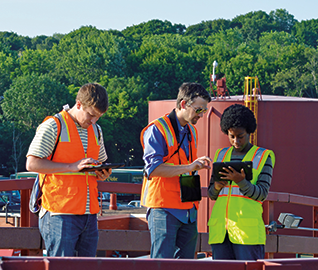
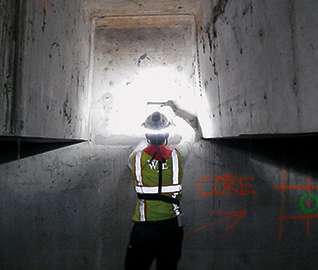
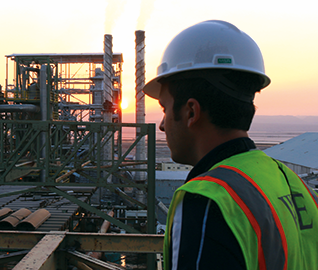
WJE has investigated major structural collapses in the United States and around the world since the 1970s, frequently arriving on-site within 24 hours of a failure or natural disaster. Though every event is unique, the immediate aftermath and subsequent investigation often follow a similar sequence: from rescue and recovery, media relations, and preservation of key evidence to documentation of conditions at the site, procurement and testing of construction materials, and structural analyses.
In this webinar, structural engineers Matthew Fadden and Gary Klein draw on decades of personal experience to explain primary considerations during the aftermath of a collapse and describe key steps during the investigation. They share personal insights and lessons learned from their investigation of the Kansas City Hyatt Regency Hotel walkway collapses (1981), Koror-Babeldaob Bridge collapse (Republic of Palau, 1996), World Trade Center attack (New York, 2001), I-35 Bridge collapse (Minneapolis, 2007), and Champlain Towers Condominium collapse (Surfside, Florida, 2021).
more to learn
View this webinar in our interactive audience console to earn 1 AIA HSW learning unit, access related resources, submit questions to the presenters, and download a certificate of completion.
LIZ PIMPER
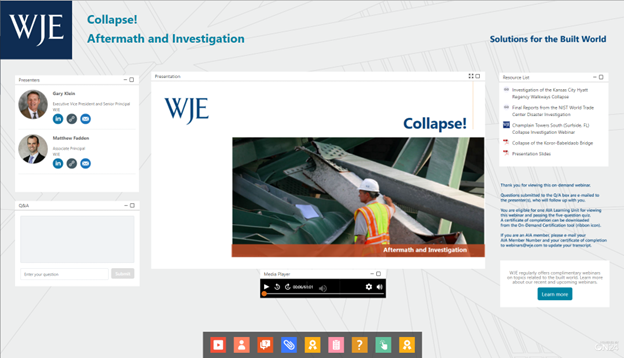
Hello and welcome to today's WJE webinar, Collapse! Aftermath and Investigation. My name is Liz Pimper and I'll be your moderator. During the next hour, structural engineers, Matthew Fadden and Gary Klein will draw on decades of personal experience to explain primary considerations during the aftermath of a collapse, and will describe key steps during the investigation. This presentation is copyrighted by Wiss, Janney, Elstner Associates. And now I will turn it over to Gary to get us started. Gary.
GARY KLEIN
Thanks, Liz. Well, good afternoon. If you're on the West Coast, good morning. My name is Gary Klein, executive vice president and senior principal at WJE. I'm here with my colleague Matt Fadden. Matt is an associate principal with WJE South Florida office and we'll be presenting the slides related to the 2021 collapse of Champlain Towers South.
MATT FADDEN
Thank you, Gary. Hello and good morning and good afternoon to everyone.
GARY KLEIN
For more than 60 years, the engineers, architects, and scientists at WJE have delivered solutions to problems in the built world. Perhaps our most high-profile assignments are those involving the investigation of major collapses. Based on our experience with these collapses, this webinar is intended to provide information and insights as to what to expect in the aftermath of a major collapse and key consideration in the investigation. This information is given from the perspective of a collapse investigator, but we hope that it is useful to all types of WJE clients, including owners, contractors, attorneys, insurance executives, and others. Let's get started with a brief background of major collapses that serve as the basis of our observations and recommendations today.
All these major collapses involve loss of life and injuries, and I will be reporting those statistics. In doing so, I don't mean to be indifferent to the personal tragedies of the victims and their families. Even in the role of an investigator after the fact, you can't help but get a sense of the human suffering each of these catastrophes represents. And it is precisely that cost in human suffering that motivates us to share the lessons learned from these events.
During a tea dance on July 17th, 1981, the suspended walkways through the lobby of the Kansas City Hyatt Regency Hotel collapsed, killing 114 people and injuring 216 others. Excluding collapses resulting from terrorist acts, it remains the deadliest structural collapse in US history. The so-called skywalks were suspended from the roof framing. The second-floor walkway was suspended from the fourth-level walkway. The collapse initiated at the upper-level connection near the middle of the walkway. The hanger rod between the roof and fourth level is represented by the blue, dashed lines. The walkway collapsed due to two mistakes. First, the connection detail was inadequate. The connection of the hanger depended on the transverse bending strength of two small channels welded toe-to-toe, which folded inward at the hanger rod connection. Second, the hanger rods were reconfigured as can be seen by comparing the design connection detail at the left to the as-built detail to the right. The reconfiguration doubled the amount of load transferred at the fourth-level connection. These mistakes led to twice as much load being transferred at a connection whose design was inadequate in the first place.
In September 1996, six months after the post-tension concrete bridge was retrofitted to correct mid-span sag, the 790-foot main span of the Koror-Babeldaob Bridge, also known as the KB Bridge suddenly collapsed into the Toachel Channel. The cast-in-place post-tension box girder bridge was built in the mid-1970s. Two motorists were killed and four more were injured. Local fishermen and dive shop operators managed to save many more who plunged into the one-hundred-foot deep channel with a swift tidal current.
This slide illustrates the final retrofit design to correct the mid-span sag. After value engineering, the designer agreed to add eight new post-tensioning tendons inside the box, which are shown in green, as well as flat jacks in the center hinge, which were used to lift and separate the cantilevers. The final step in correcting the sag was to add 240-foot concrete ramp in the mid-span region. The retrofit, especially the flat jacks, added considerable compressive stress to the top flange. Over the pier supports, there was very little concrete between the 310 post-tensioning tendons. As such, the added compressive stress led to planar cracks between the tendons, separating the flange into multiple layers. This in turn, led to compression failure of the top flange due to buckling of the individual laminations, a phenomenon known as lamellar buckling.
The next series of slides illustrates the progression of the collapse after compression failure on the Airai side of the bridge. Loss of the top flange triggered compression failures of the web walls and bottom flange, such that the Airai side cantilever shifted to the right opening the center hinge. As the Airai cantilever collapsed, the new construction tendons pulled down on the Koror cantilever. Both cantilevers then collapsed, eventually coming to rest on the bottom of the channel.
The Twin Towers of the World Trade Center collapsed on September 11th, 2001, shortly after hijacked airliners flew into the towers. A terrorist attack killed 2,752 people including passengers and crew of the two airplanes. Following the attack, hundreds of police, firefighters, contractors and engineers, as well as volunteers from across the US worked to rescue survivors, recover bodies and clean up the site. The initial impacts of the airplanes destroyed the outer columns over most of the width of the buildings. It's difficult to see, but notice the person in the yellow oval standing at the perimeter of the opening, which can be seen more clearly in this blow-up. It's truly heartbreaking.
As to cause, NIST, the National Institute of Standards and Technology, concluded that the collapse of each tower resulted from the combined effects of airplane impact damage, widespread fireproofing dislodgement, and the fires that ensued. From a structural engineer's perspective, it is noteworthy that the towers remained standing after the initial impacts. In spite of severe structural damage, the North Tower stood for an hour and 42 minutes after impact. The South Tower collapsed 56 minutes after impact. Had the towers not withstood the initial impacts, the death toll would've been much higher. 10,000 to 25,000 more deaths according to some estimates.
During the evening rush hour on August 1st, 2007, the I-35W Bridge suddenly collapsed, killing 13 people and injuring 135. The central navigation span of the continuous below-deck truss bridge was 456 feet long. Emergency personnel and civilians worked through the night, rescuing people who were trapped in their vehicles. 75 local, state and federal agencies were involved in the rescue and recovery. Most investigations, including separate investigations by NTSB and WJE concluded that the primary cause was horizontal shear of the top cord gusset plate along the dashed line shown here. The gusset plates should have been thicker. In other words, a design error. Construction materials stored on the bridge contributed.
MATT FADDEN
Thanks for introducing those, Gary. The final collapse that we'll talk about today is the most recent one as well, and that's the partial collapse of the Champlain Towers South Condominium. Champlain Towers South was a conventionally reinforced 12-story, 136-unit beachfront condo in Surfside, Florida. And it was constructed in 1981. The partial and disproportionate collapse of Champlain Towers South was devastating. An event that occurred on June 24th, 2021, just over three years ago now. This tragedy claimed 98 lives and has profoundly impacted the local community in Florida as well as how we treat buildings and inspections of buildings statewide. Following the collapse, the condominium's association's receivership hired WJE to assist in the investigation and provide expert witness and consulting services. In the next few slides, we'll briefly discuss some of the critical factors that contributed to the collapse.
Here you should be seeing now a video of the actual collapse of the tower taken from a building just to the south in surveillance footage. Thankfully we have that video. It shows that the building at the east end of the building, what appears to be collapsing, from near the central core down to the backside and then the far eastern portion remained standing until the small shear wall there gave way. What the video doesn't show is that WJE's investigation determined that the collapse was a result of punching shear failures to the pool deck. Several observations led us to this conclusion. The neck was never designed appropriately. For example, there was a 70% overstress at column K13.1, which I'm showing here on the screen, which is supporting that pool deck.
In 1996, a contractor working on the structure, along with an engineer, added more load to this deck. It was not originally covered with pavers, which also include a sand bed layer and waterproofing. This is significant. Video evidence and eyewitness reports confirmed that the pool deck actually collapsed first, about 12 minutes before the rest of the building. Unfortunately, the engineers working on site missed telling signs of punching shear related distress. And here are two of those photos that we found. Consider the photos from November of 2020 and of June of 2021. On the left, we see a photo showing efflorescence and water staining on a column. This is indicative of punching shear related distress. The photo of k13.1 on the right is just taken a few weeks before the collapse and shows large vertical movements of the pool deck reflecting into the planters. Unfortunately, neither of these really sound an alarm to shore or to stabilize the structure.
So now let's take a cut and look around K13.1 and see how the collapse manifested. So imagine now we're standing at this L13.1 and we're going to look to the west, away from the beach here. And now we're looking at the slab, and this is prior to any sort of failure happening, in its original state. Given the design failures, so the significant under design of the structure, shear and flexural cracking were highly likely, and so we show that here in this image. We know that around early June of 2021, just a few weeks before the collapse, there was some significant movement of the slab in reflecting into the planters, and that is showing this distress on this piece of the animation. On June 24th 2021, at about 1:10 in the morning, the pool deck collapsed as a result of punching shear failures. And to explain that.
Shear, is a mechanism essentially where the deck would come down and the column punches through. That's all it is.
And so to explain that, that was obviously me on the news, and we will talk more about dealing with the news later. However, the idea is that the punching shear failures then, as a result of the inadequate design spread. One fails and now you have an inadequate design and the other columns are unable to take that load. As this building moves and deflects under large displacements, now we start needing to consider horizontal forces. And those horizontal forces represented by the orange arrows on the right, damage the columns at the south face of the building, and that's why the building appears to be collapsing from the south. There was significant movement of the columns once the collapse of the pool deck happened, and this was reflected and confirmed by video footage and eyewitness accounts.
Finally, the building collapsed about 12 minutes after the collapse of the pool deck. So this building suffered a disproportionate collapse, where a small collapse led to a larger collapse, and thankfully only partial collapse of the rest of the structure.
GARY KLEIN
I know you may want more detail as to why these tragedies happened. Let me apologize in advance. As I said, our objective is to explain what to expect in the aftermath of a collapse and describe the key steps in the investigation. There are simply not enough time to explain the technical causes of these collapses in more detail. However, in the resources list on your screen, there is a list of links to articles, reports and presentations that delve into the causes of these collapses.
So let's get into it. What happens in the aftermath of a failure? Well, the key considerations are of course, rescue and recovery and site control and safety. Who are the interested parties? The need to preserve key evidence. And finally, restoring service or resuming construction. Details will provided in the slides that follow. So regarding rescue and recovery and using the KC Hyatt as an example, after the collapse, emergency medical teams, firefighters and police work through the night to rescue survivors. Local construction contractors provided equipment including forklifts and cranes. The cranes used to lift the walkway segments was positioned outside the hotel and can be seen in the red oval shown on the slide. The crane boom broke through the plate class windows. The rapid and coordinated response is considered a textbook example of how best to respond to a major collapse.
MATT FADDEN
Immediately following the Champlain Towers collapse, a significant search and rescue effort was undertaken, and the site was controlled by both the Miami-Dade police and fire units, as well as FEMA sent urban search and rescue units to the site. In addition, other parties helped throughout the rescue and recovery effort, including the Israelis Defense Force and members of other nonprofit organizations. This site then remained as a rescue and recovery operation for nearly a month.
GARY KLEIN
In the wake of the World Trade Center collapse, the tireless work of police, firefighters and other first responders was amazing, especially in the early hours. Constructional engineers provided support to police, firefighters and construction workers to investigate condition of partially damaged buildings and potentially unstable debris piles. The structural engineer's role was in support of that of the primary first responders, and I was part of that effort. Seen here assessing the safety of a subway tunnel underneath the debris. The key takeaway is that during rescue and recovery, the first responders are in charge and calling the shots, but they may need outside support such as rescue teams, search and rescue dogs, heavy or specialized equipment, and even structural engineers. In my experience, these groups are anxious to help in the wake of a disaster.
Now, let's move to site control and safety. It may not always be clear who is in charge in the aftermath of a collapse. Usually, if the facility is in use, the owner or property manager has control of the site after it is turned over by the rescue and recovery team. Facilities under construction are in the control of the contractor or construction manager. However, government agencies may also exercise their right to carry out an investigation. And, if criminal activity is a suspected cause, law enforcement may declare the site a crime scene and assume control, which is what happened after the Champlain Towers collapse. By law, the National Transportation Safety Board, or NTSB, is required to investigate bridge collapses that result in loss of life. The site and key evidence are under their control and they have the power to subpoena and interview involved parties. The National Construction Safety Team, NCST, operates under NIST. NCST chooses their investigations based on the significance of the collapse. Of course, they chose to investigate at Champlain Towers. Finally, if the site is under construction at the time of the collapse and workers are injured, OSHA may investigate.
Collapsed sites are inherently dangerous, and the safety rules developed for construction sites do not necessarily apply. Early on, access should be limited to personnel trained in site safety and collapse investigation. While access to construction sites is usually controlled, there is no security perimeter in place following collapse of a facility in use. The media and general public will attempt to gain close-up access. Immediately following the collapse, the local police can be helpful in setting up and enforcing temporary perimeter until a more permanent security measures can be established. Although I did not preview it, the partial collapse of the Grant Park North underground garage, shown here, is an interesting case in site control and safety. Police had set up a barrier at the partial collapse of an underground parking structure in Chicago, but several people walked inside the barrier, which can be seen by the blue arrow. The entourage included then Mayor, Jane Byrne, who's in the middle of the group, her daughter, several park district officials, and the news media. Now, finally, note the condition of the beam supporting the sidewalk on which they are all standing. As I said, collapsed sites are inherently dangerous.
Within two or three days after the collapse of the World Trade Center Towers, officials developed guidelines for site safety and personal protective equipment. Respirators were provided to everyone entering the site and their use was strongly recommended. However, in this close-up, only one person can be seen wearing a respirator. Tragically, decades later, many of the first responders and others involved in the rescue and recovery efforts have developed debilitating and permanent loss of lung function. As soon as practicable, site-specific guidelines for safe access should be developed, and of course, followed.
MATT FADDEN
At Champlain Towers, every site takes a life of its own, and I think Gary will add to this here in a few minutes. The police constructed barricades and blocked off several city blocks, and in the back of this photo you can see some of the police and first responder presence at the site. Collins Avenue, which is the main drag, which is the street you can see right behind Champlain Towers there, was actually closed for months. And so this brings up actually my most recent brush with the law, which was, right after the collapse happened, and not just right after, but several weeks after the collapse happened, the site was heavily restricted.
However, we were hired by the ownership group. And so after the initial immediate response had subsided, I went to the site, in attempt to gain access on behalf of our client, and understand what was going on and make observations. Unfortunately, that was met with a trespass warning and severe displeasure from the local police department. And so it wasn't really until almost three months later I was able to gain access to the site. I've had different experiences at other collapse sites, so every one of these is different.
Undoubtedly, when there's a collapse, especially when they're catastrophic, many interested parties will be involved. Whether it be the ownership or stakeholders or other stakeholders, that include property managers, a contractor if the site is under construction, and their construction manager and subcontractors. And suppliers, if there's certain pieces of equipment used as well. And designers, designers will always be there and that will often be the structural engineer record. Other interested parties that will typically appear is the attorneys representing the stakeholders and victims and also investigators for the stakeholders. Whether those be other engineers like Gary and me or other sorts of investigators throughout, such as NIST and whatnot. Politicians will always and almost undoubtedly be at the site. And as you saw, Jane Byrne at the Chicago garage collapse, the politicians were also very good at getting access to the site and getting photos as well. The media will undoubtedly be very interested in a large collapse, and that is not any different with Champlain Towers, which we'll talk about here next.
Following the Champlain Towers collapse, Mayor Levine Cava and Governor Ron DeSantis and their offices organized and coordinated state and federal resources. After the collapse, there's always, as I mentioned, an overwhelming media interest. As an organization and as an owner, you should think to have a plan worked out in advance with your organization's communications and legal team to handle an event if anything were to happen. It may be prudent to have a crisis communicator on retainer. And the plan should include things like designating a spokesperson, designating a crisis communication team, possible scenarios in a draft statement for release to the media, and how you accommodate media needs on site. For instance, you saw me on the news earlier, I didn't do that news interview near any time when I was doing the investigation. It's very much dependent on what your client wants. At the same time, that all went through our communications department.
Investigators must but also be prepared to advise your client and expect inquiries. Find out who your client wants to designate for media inquiries. At WJE, for instance, it all goes through our communications group. Do not respond to inquiries or requests for interviews unless your client requests you to. For instance, especially if you're on a litigation. Make sure others in your firm know where to direct inquiries and it can be as simple as just saying, "Email so-and-so." And follow your client's lead. Ultimately, it's your client's decision if they want you to speak to the media or not.
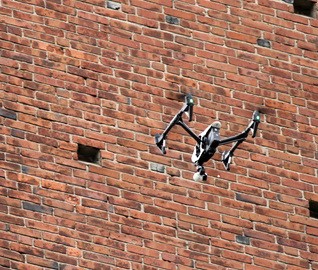
In the wake of a major collapse, efforts should also be taken to preserve evidence. And so at Champlain Towers South, for instance, NIST and their national construction safety team, as well as the Miami-Dade County Sheriff, triaged many different specimens or remnants of the structure at the collapsed site and then brought them to two warehouse bays near the airport in Miami. Here you can see two WJE associates flying a drone over all of the specimens that NIST and Miami-Dade County had collected and stored in this warehouse. I have to give them some credit, and by them, I mean NIST as well as Miami-Dade County. They preserved many very useful specimens and a very tight space. And so tight, you can see that, if you look at the ceiling, not many of the lights are working. There was really no way for them to replace lights and deal with any of that sort of maintenance-level kind of issues inside of their building. And to that end, they have since subsequently moved evidence into a different area for a better investigation.
Here you can see one of the most useful pieces that we found there, and that's my hand pointing at a half of a punched slab confirming our thoughts and also providing additional evidence for our understanding regarding the construction at Champlain Towers.
GARY KLEIN
Others, not so much. Anyway, moving on to restoring service or resuming construction. Shortly after the responders have left, there's likely to be intense interest in restoring service to an operating facility or resuming construction of a partially completed structure. Costs associated with loss of use of an operating facility can far exceed the cost of repair, and there's a tremendous public cost when a vital transportation link is severed. Likewise, lost time due to partial collapse of facility under construction can lead to delay claims that are greater than the cost of rebuilding the damaged area. A few days after the Kansas City Hyatt collapse, shown here, we advised the hotel owner to move the walkway segments to a safe off-site warehouse before legal maneuvering prevented them from doing so. The ownership took our advice, relocating the walkway segments five days the collapse as reporters looked on from an adjacent office building. While the owner was criticized in the press, they were able to reopen the hotel just three months after the collapse. Years later, the owner switched innkeepers and the hotel is now known as Sheraton Kansas City Hotel at Crown Center.
Okay, let's move on to the investigation side. After the dust has settled and the first responders have turned over the site, the investigation can begin in earnest. Key steps and considerations include the investigation team, project document review, sharing information and resources, documentation of conditions at the site, procurement and testing of construction materials, structural analyses, and tests of surviving elements and replicas. If you're an involved party looking for an expert, you should consider retaining a qualified investigation firm, and expert, as soon as possible because other parties will be trying to do the same thing.
A qualified structural engineering consultant can be of considerable help to the owner as well as public agencies responsible for collapse investigations. Both investigation and experience and expertise are important. Clients rely on experienced structural investigators like our friend Sherlock Holmes for advice as to how to determine what happened. At the same time, lead investigators must have established expertise, as represented by Albert Einstein, to lend credibility to their investigation findings and possibly their expert testimony in subsequent deposition and trial. If possible, the lead investigator should have both requisite experience and expertise. So this is a person you may be looking for, or maybe not. As Matt said, "Kind of a dad joke."
All right, moving on to project document review. After being hired to lead an investigation, I'm sometimes asked, "Where do you start?" And the answer is, "If possible, you should start by reviewing the available project documents before walking around the site willy-nilly not knowing what you're looking at." Don't get me wrong, you should try to get to the site while the evidence is fresh, but it always pays to review available project documents in advance to formulate an investigation plan. These documents include plans, specifications, correspondence, engineering reports, relevant codes and standards, and of course photographs. As Matt will explain, finding and understanding the significance of photographs shown here was crucial in determining the cause of the Champlain Towers collapse.
MATT FADDEN
Thanks, Gary. I showed this photo earlier, but finding this was critical to our investigation. It's important to request documents from involved parties, jurisdictions, as well as items that will be discovered as part of the litigation, and thoroughly review them. In the instance of the Surfside collapse, Surfside posted all documents that they had to a website. These photos that you see come from the engineer working at the site at the time, noting the distress to the planter. And you can actually see, in the very far left corner, on the top of the trash can, the hand of the property manager. The property manager is showing the engineer what he's seeing and the distress to these planters. Ultimately, the engineer at the time attributed this to the roots of the plants causing this distress, but clearly vertical movement wouldn't do that, or the vertical movement that we see wouldn't be a result of plants and roots.
A different designer had taken a photo of that same planter about a year before the actual collapse. And what we can see is there was no damage at the time. And so it is important to look through many, many different photos. And I spent many of an hour clicking, clicking, clicking, looking at photos of nothing. And sometimes very interesting information comes up. We certainly wouldn't be as confident in our belief about what happened at Champlain Towers if we didn't have these photos.
At the same time, there will be many interested parties. And Champlain Towers was no different. I've been involved in other investigations as well where the parties have a shared protocol for testing. At Champlain Towers South, WJE was in a unique position because we were the representatives for the owner. The owner had some control of the site once it returned back to their control, essentially. Although it was in litigation and they had to be very careful with making sure that all parties were provided significant access. Knowing that there was not enough samples and there was no need to have 14 different concurring, or not concurring, 14 differing investigations happening at the site at the same time, the idea was put out to develop a joint testing protocol.
The joint testing protocol really allowed every engineering firm to get what they needed done at the site in terms of sampling and measurements and other sorts of activities to be carried out by a third-party engineering firm that was indifferent to the investigation. This is not normal, but this was what happened at Champlain Towers. Often, you'll see, for smaller collapses, parties just doing their own thing.
GARY KLEIN
After the 2007 collapse of the I-35W Bridge, then-Governor, Tim Pawlenty directed the State Department of Transportation to hire WJE to carry out an investigation. The governor made that decision after receiving a recommendation from the governor of Massachusetts, Mitt Romney. A year earlier, Governor Romney worked closely with WJE to carry out a stem-to-stern safety audit of Boston's Big Dig after several precast concrete ceiling panels collapsed, killing a passenger on the way to the airport. At the same time, NTSB claimed authority to conduct the investigation. The state and NTSB worked out an arrangement where WJE and NTSB would work to carry out parallel, independent investigations, but share resources and access to evidence. One of the key steps was removal of truss members from the Mississippi River to a lay-down area for subsequent inspection.
Of course, the approach to documentation of site conditions varies considerably with each investigation. The following guidelines have proved to be effective. First, establish a reference system. The investigation team should endeavor to agree upon a common system to avoid later confusion when findings are issued and compared. Of course, document conditions using notes, measurements and photographs both aerial and conventional, and drones can be especially useful here. Consider a 3D laser survey to establish precise positions of the collapsed members. You should survey impact and scrape marks that may help determine the direction and progression of the collapse. And pay particular attention to clean breaks as possible locations of failure initiation. Severe distortion is usually an indication of damage occurring after the initial failure at another location.
And finally, consider site instrumentation such as measurement of thermal gradient or strain relief or any number of things that may help in the investigation. In the case of a major bridge collapses like that of the Koror-Babeldaob Bridge, the evidence was under water and could not reasonably be retrieved. So the best choice was to use scuba to document site conditions. We lined up a dive firm to help us, and all of the high-end dive shops were busy with tourist excursions, but we managed to find Fish 'n Fins who provided equipment and support, and did a great job.
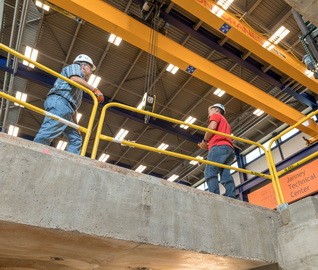
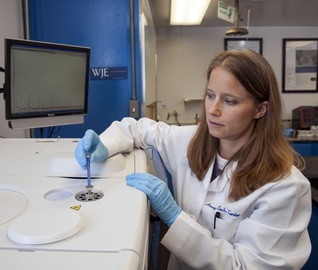
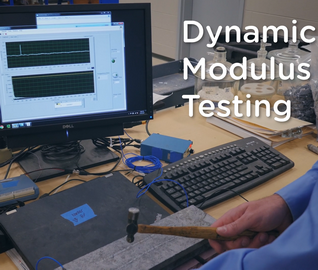
A careful plan for procurement and testing of construction materials is required. As previously described by Matt, there is no need for duplicative tests by multiple parties if the investigations team can agree on a trusted independent laboratory. And realize, that test results may later be challenged possibly in court. Tests should be carried out by experienced staff. If applicable, tests should be carried out in accordance with recognized standards such as those available from ASTM International. Regarding my work in structural investigations, I can't begin to tell you how great it is to be backed up by the engineers and material scientists at the Janney Technical Center. Shown here.
MATT FADDEN
And nearly undoubtedly when you have a structural collapse, there will also be a structural investigation or structural analysis as part of that collapse investigation. The analysis should be based on the material properties and conditions at the site at the time of the collapse. Understanding collapse is not understanding design. Code equations and [inaudible 00:40:25] assumptions used in design are often inappropriate and can be misleading. For instance, at Champlain Towers, the punching shear capacities listed in ACI 318, those at the time of construction, and those used now today, may be inappropriate for the conditions at the site. Instead, use procedures and equations that will give a realistic prediction of behavior. For instance, something like critical shear crack theory would give a more predictable and more accurate understanding of the punching shear capacity of the slabs at Champlain Towers.
On the other hand, a separate analysis using code equations and design loads is appropriate to determine whether or not the structural design met the governing codes. And again, I earlier alluded to the fact that Champlain Towers was significantly under-designed. Here, you can see this model showing the design loads and capacities in this columns, essentially, at Champlain Towers during the collapse. This model was used for significant understanding of the different components and doing a thorough design review of the towers itself. We didn't find any significant mis designs outside of the pool deck area. However, our scope wasn't extensive to every section or every slab of the entire building.
GARY KLEIN
It was Wernher von Braun, the famous German rocket scientist, who said, "One test is worth 1,000 expert opinions." Tests of surviving elements and replicas provide conclusive evidence. Of course, the test must accurately represent the conditions and material properties at the time of collapse, or at least you should account for any differences. Agencies like NTSB and NCST of course take first choice as to the evidence to be examined and tested so testing of replicas may be needed. Which was the case after the collapse of the Hyatt box beams, or the Hyatt walkways, I should say. Tests of replicas of the box beams in Hyatt Regency Kansas City were used extensively by several investigation teams, including the tests shown above conducted in WJE's laboratory. The failed box beam that was replicated, as shown at the left, and a box beam after testing, as shown at the right.
Okay, Matt and I will leave you with one final thought, and Matt has already alluded to this. Each major collapse takes on a personality of its own. It's virtually certain that the details of the aftermath and investigation considerations will vary greatly from case-to-case, depending on the nature of the collapse, the involved party, as well as the type and extent of government involvement. Well, we hope that you never have to consider today's presentation as a party to a major collapse, but we also hope that you found our observations interesting, informative, and useful. Thank you for your time. And Matt and I would be happy to address any questions.
LIZ PIMPER
All right, thank you, Gary, and thanks, Matt. All right, let's take our first question. It's kind of a long one. The question is, "Will you talk about the unfortunate change in structural engineering ever since the KC walkway failure? It was terrible for sure, but it made multiple generations of structural engineers over-conservative, sometimes to the point of ridiculousness with factors of safety increased many times over. All over what was essentially a submittal/shop drawing process problem. Is that correct?"
GARY KLEIN
Well, I would take exception to that driving change in terms of level of safety factors, but you are correct that it changed the way that we review delegated designs. In the case of many steel frame buildings, a connection design is delegated to the fabricator. And in the case of the Hyatt, however, there was little to be left to the imagination, and the fabricator initially provided what was shown on the drawings except for the change in walkway arrangement, which was ultimately approved by the engineer of record. And anyway, that has led to better processes around those kinds of changes made during the course of construction. But load factors and safety factors, I don't think have changed a great deal, at least in my experience.
LIZ PIMPER
All right, this next question is about the I-35 West project. "Please clarify the Mississippi River Bridge, in that you said gusset plates were too thin. Does this not mean those were potentially just the weakest link and first to fail? If the gussets were thicker, then the next weakest link would've failed?"
GARY KLEIN
No, the gusset was simply too thin. Similar gusset plates were about twice as thick, and so it was a design problem that didn't make itself evident till decades after the initial design when they were doing some construction on the deck and there were construction materials on the deck, so that span, it's probably seen the heaviest loads it ever saw. But had they got it right on that gusset plate and its companion gusset plates, in our opinion, the bridge would not have collapsed.
LIZ PIMPER
Matt, this is a question for you. "For the Champlain Towers collapse, I believe you stated that the building was constructed in 1981. Is it accurate to say that a punching sheer design failure was the cause of the collapse given that the building stood for approximately 40 years?"
MATT FADDEN
Yeah, that's a great question. We need to remember two things. One is that the building had additional load added to it. And so the idea that... Let's just start with two things I guess. Let me take a step back here. The building always had a mis design, and so it was always in kind of an overloaded state, or i.e., the safety of that, or reliability, of that structure was never what it was intended to be. And in 1996, additional load was added to the structure and that caused, likely, distress to the slab itself. But we also need to remember that concrete is a time-dependent material. Things like creep is real in concrete.
And when something's near its actual design load for many years, or actual capacity, not design load I should say, near its actual capacity for many years, concrete is certainly going to slowly move or slowly develop more and more distress. And for instance, you saw in the two different photos I showed of columns, distress, moving from, we know, from one column to the other, essentially L13.1 having an issue in December or November of 2020, then K13.1 seeing another issue. And so the idea is that the likely distress was moving around on this deck for quite some time and slowly developing.
LIZ PIMPER
Matt, another question related to Champlain Towers, "Did you say Israeli Defense Forces were involved in the aftermath of the collapse? Why was that?"
MATT FADDEN
Yeah, that's a great question. The Israeli Defense Forces as well as some other Jewish faith-based organizations were involved, and it's because Surfside is a highly Jewish community with many different folks that come down from New York or from Israel and they live in that area. And so it is very specific to Surfside itself. And so that is why you would see things like that, like the Israeli Defense Force and some other Israeli organizations involved.
LIZ PIMPER
All right, another one for you, Matt, "NIST intends to provide a review of their findings in 2026. This is a departure from all previous investigations. Why is NIST taking five years to provide a report?"
MATT FADDEN
Yeah, that's a great question. When we think about what NIST is doing, we really have to think that the standard that they're trying to live up to, and what they're working on is a research-based approach to understanding the collapse itself. So the standard for NIST is very high, and I think that that is part of why the timeline is extended, and so long. NIST has many different aspects that we didn't even touch upon in terms of interviewing folks that were involved in the collapse and families that lost loved ones, understanding many different parts of the effect of the collapse in terms of the societal impacts. But also, they have testing that they're doing in terms of large-scale experimental testing and other pieces to help back their claim. You have to understand that their approach is highly technical and very thorough and undoubtedly will come with very good results and understanding.
LIZ PIMPER
Okay. The next question. "In your experience, where there's joint testing amongst the parties, is there a sharing of project documentation during that phase as well, or does that generally occur during discovery?"
GARY KLEIN
I'll take a shot and then perhaps you can follow up.
MATT FADDEN
Yeah, I'll add in Gary, after you. Go ahead and start it.
GARY KLEIN
Yeah, so no, the answer is, as we said early on, these things take a personality of their own. Sometimes the involved parties are very cooperative and happy to share documents informally, others not so much. In which case with, eventually, these documents can be subpoenas, which slows down the process in my view. But in my opinion, those kinds of documents that will have to be inevitably shared should be shared sooner rather than later.
MATT FADDEN
Yeah. I'll just add in, Gary, for Champlain Towers, I think the attorneys and judge understood how important it was to settle this case and put this case to rest and put that matter to rest. And so it was pretty clear that everyone was sharing things quite quickly. And so that happened there. As well, at the same time, they knew the importance of, and the necessity for, a joint testing program. And so that joint testing program was agreed upon quite quickly and nearly anything anyone wanted was allowed to be done and taken out. And there was sharing of that information as well, real-time.
GARY KLEIN
And the National Construction Safety Team actually asked us, based on our investigative work on behalf of ownership, what information did we acquire that we would be willing to share with the National Construction Safety Team? And ownership was more than happy to cooperate in the federal investigation. To their credit.
MATT FADDEN
Yeah, to their credit, yes. Everything from the joint testing program has been shared with NIST as well. That was all given over to them after the settlement of the case.
LIZ PIMPER
"What happens when members of the team reach different conclusions as to the reason for failure?"
MATT FADDEN
There's a different team?
GARY KLEIN
So that's a great question. Yeah. I assume that question was... Repeat the question, would you Liz?
LIZ PIMPER
Sure. And I believe what this person was asking is, what happens when different teams that are investigating a collapse reached different conclusions as to the reason for failure?
GARY KLEIN
And that's a great question, and that happens. Different teams representing different parties come to different conclusions. We saw that in I-35W. Often the conclusions align. And when they differ, if the case is headed to litigation, that's where those differences come to light, and experts give testimony and sometimes differing testimony as to the cause. So that's the mechanism. When federal agencies such as NTSB and the National Construction Safety Team issue their report, however, they're usually not part of some subsequent litigation. They simply say, "This is what we did." They're very thorough, which is one of the reason it takes so long, and they issue a report that says, "This is it." And they don't want to be, and shy away from being, part of any subsequent litigation.
LIZ PIMPER
Okay. "How do you draw the line between explaining what happened and affixing blame?"
GARY KLEIN
Well, that's also a good-
MATT FADDEN
Gary, I can jump on that for Champlain.
GARY KLEIN
Yeah, go ahead.
MATT FADDEN
Yeah. So it is a very careful task that we're all entrusted with when we do that. And so typically, and thankfully for Champlain Towers, we didn't really need to get to a point to affixing blame. And as you can tell, we've been very careful with how we handle the pointing of blame at this point in time. And so we're careful with naming people and saying things about what was done at the site. I think there may be a time when that's not less appropriate or less necessary, so it is a careful thing that you should consider with people who have been through these experiences before and potentially with legal counsel as well.
GARY KLEIN
And I would only add, I think that's a great question. You first have to understand what happened. And then affixing blame though, you have to be careful. You shouldn't be placing blame unless you fully understand and have reviewed the contractual obligations of the various parties. And if you have any access to their agreements and so on, you really have no business of affixing blame based on an assumption of what you think their responsibilities should have been.
LIZ PIMPER
Okay. We've got two questions that are related to education and training around evaluating failures. The first is, "Is there official training or certification for licensed professionals to use to evaluate structures after a disaster?" And the second is, "How does one get into forensic engineering? Are there universities that offer classes on this?"
GARY KLEIN
There's training around things like responses after earthquakes and how to rate buildings and those types of things. Less so on just individual collapses of buildings. There isn't official training. And that's where, as I said, both the experience in these types of things as well as expertise are important in carrying out these investigations. Universities more and more are including forensic-type classes. I know we work with several of them offering our experience in collapse investigations in seminars for students at these universities.
LIZ PIMPER
Okay. We have time for about one more question. And we'll take this one. "Existing buildings rarely see thorough inspections after occupancy. Is there any movement toward regulations that require more comprehensive inspections for buildings like condominiums to ensure the safety of its occupants in the neighboring area?"
MATT FADDEN
Gary, I want to take that since it's in Florida and it's happening.
GARY KLEIN
Yes, you should.
MATT FADDEN
Yeah. So after the Champlain Towers collapsed, the state enacted bills sponsored by the Senate, SB4D, which requires the inspection of buildings or all condo buildings throughout the state as well as co-ops and other sorts of things. You are correct, most buildings undergo very limited inspections after their construction. I think the one thing that we need to remember though is that the vast majority, and by vast majority, I mean nearly all buildings, are safe. The design of buildings is very robust. We have many different load paths and ductilities that are in a structure that can account for lots of things not considered in the initial design. Typically, it takes a non-ductile failure and overloading in certain areas to cause something like what you saw with Champlain Towers.
To that end, recently, the idea that inspecting or looking at a building and visual inspections can improve structural safety has been put out there. There's some disagreement and potential kind of thinking that this is a good point in terms of what we should be doing for the industry. And there's also some disagreement regarding the idea that buildings are generally unsafe. It is always a good idea to inspect your building and continue to maintain your building, but that's different than structural safety. It's nuanced, but it's different. That's a long-winded answer, but it's a very challenging question, to be honest, what to do about that.
LIZ PIMPER
Okay. Well, thank you, Matt, and thank you, Gary for the great presentation. That is all the time that we have for questions today. We've got a lot of really good ones in the queue that we didn't get to, and as I said before, we'll make sure that Gary or Matt follows up with you. Thank you very much for joining us for the presentation today, we hope it's been educational. So again, thank you so much for your time and we hope you have a great rest of the day.
RELATED INFORMATION
-
 Gary J. Klein, Vice President and Senior PrincipalWJE Northbrook MORE >People | Gary J. Klein, Vice President and Senior Principal
 -
 Thousands of clients have relied on us to accurately determine the cause and extent of damage... MORE >Services | Failure and Damage Investigation
 -
 Learn about WJE’s investigation and findings, including our collapse theory. MORE >Webinars | Champlain Towers South (Surfside, FL) Collapse Investigation